Goats will eat almost anything, but that doesn’t mean they should. What actually keeps a goat healthy, producing well, and free of digestive problems is a specific stack of feeds, and the order of priority matters. Here’s how to build that stack, from the foundation up.
Step 1: Start with hay as the foundation
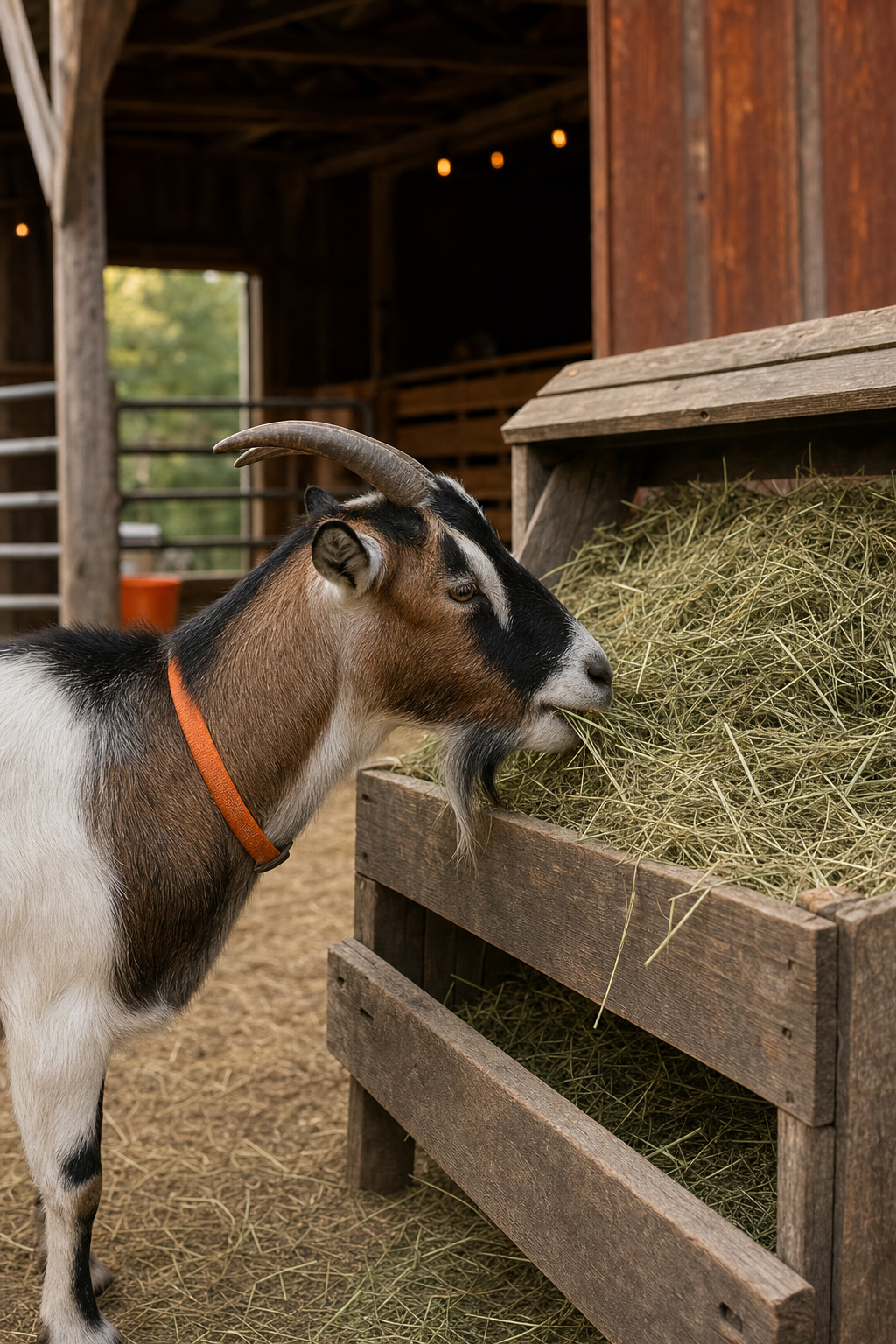
Hay is the single most important thing in a goat’s diet. Before grain, before pellets, before minerals , hay comes first. It provides the long-stem fiber that keeps the rumen moving correctly, and without it, everything else in the feeding program falls apart.
The type of hay matters. Alfalfa is high in protein and calcium, which makes it excellent for pregnant and lactating does or young kids. But it’s too rich for adult wethers or dry does , feed it long-term to those animals and you risk urinary calculi in males and weight gain in everyone else. Grass hay like Timothy or orchard grass is a better everyday choice for the general herd. It’s lower in protein and calcium, which keeps things balanced.
Coastal Bermuda is widely used in the Southeast and works well as a free-choice base hay. The key word is free choice. Goats should have access to hay at all times, not rationed twice a day like you’d feed a dog. A well-stocked feeder at all hours is the simplest thing you can do for rumen health.
Quality matters as much as type. Moldy hay causes digestive problems fast. Check every bale you bring home: it should smell clean and grassy, not musty. Look for hay that was cut before it went to seed , that’s when nutrient density peaks. If you’re not sure where to source good hay locally, comparing local hay sources by feed store, farm direct, and co-op can save you both money and quality headaches.
In summer when pasture is good, your goats may ignore the hay feeder. That’s fine. Keep a little out anyway for rumen health. Come winter, they’ll eat a full feeder every day or two. Plan your hay storage around that seasonal swing.
Key Takeaway: Hay is the non-negotiable foundation , free-choice, good quality, and matched to your goat’s life stage before you add anything else.
Step 2: Add browse to the rotation , goats are not sheep
One of the most common mistakes new goat owners make is feeding goats the way they’d feed sheep. They’re not the same animal. Goats are intermediate browsers, meaning they naturally select browse, forbs, and other readily digestible plant materials , they’re not the grass grazers that sheep are.
In practice, this means goats thrive when they have access to woody plants, broadleaf weeds, shrubs, and tree branches. Oak leaves, muscadine grapevines, blackberry canes, and similar browse are high in nutrients and goats will actively seek them out. If you have wooded areas on your property, rotating goats through them is feeding them the way their biology expects.
Browse is also a cost-effective supplement. Oak leaves in particular are high in iron and protein. Some homesteaders collect trimmed branches and bring them into the pen. It’s low-effort and the goats eat them down to nothing.
A dry lot setup , where goats don’t have pasture access , works, but it means you have to substitute for what they’d naturally find. Extra hay, varied forages, and intentional browse days matter more in that scenario. If you’re dry-lotting to manage parasites, which is a legitimate strategy especially in humid climates, build browse into the weekly routine by hand-delivering branches.
The usable takeaway: think of your goat’s feeding area as a foraging zone, not a grass field. Goats want to eat at eye level and above, not graze low like cattle. A fence line with varied vegetation beats a manicured pasture every time.
Step 3: Set up free-choice minerals , and choose the right mix
Minerals are where a lot of goat health problems start and end. Copper deficiency causes rough coats and poor immune function. Low selenium leads to white muscle disease in kids. Zinc affects reproduction and skin health. You can feed perfect hay and still have sick animals if minerals aren’t right.
The most important rule: use loose minerals, not a mineral block. Mineral blocks are made for cattle, whose rough tongues can actually pull adequate minerals from them. Goats can’t. Their mouths aren’t built for it, and they’ll give up long before they’ve consumed a useful dose. Loose minerals in a separate feeder, available free-choice, is the only format that works.
Buy a mineral mix formulated specifically for goats, not a sheep-and-goat blend. This is a critical distinction. Goats are far more tolerant of copper than sheep, and sheep-formulated minerals intentionally cap copper to protect sheep from toxicity. That capped level leaves goats deficient. Goats fed mineral products formulated for sheep may be predisposed to copper deficiency.
One option worth knowing about is the Sheep and Goat Mineral from Hunter Nutrition, a free-choice mineral that provides 0.70 mg selenium per ounce, the maximum allowed by feed regulations. That level matters if you’re in a selenium-deficient region, which covers most of the eastern United States.
Beyond loose minerals, some goat owners supplement with a copper bolus two to three times a year, especially if the animals show signs of deficiency. Probiotics are another common addition, particularly after any antibiotic treatment or stressful event like transport or kidding.
Water quality also affects mineral absorption. High sulfate content in well water , above 500 mg/L , can bind to copper in the rumen and make it unavailable. If you’re on a well and copper deficiency keeps coming back despite adequate supplementation, test your water.
Pro Tip: Keep the mineral feeder covered or under a small roof. Wet loose minerals clump and goats stop eating them. A dry feeder costs almost nothing to rig and pays off in consistent intake.
Step 4: Use grain and pellets as a supplement, not a staple
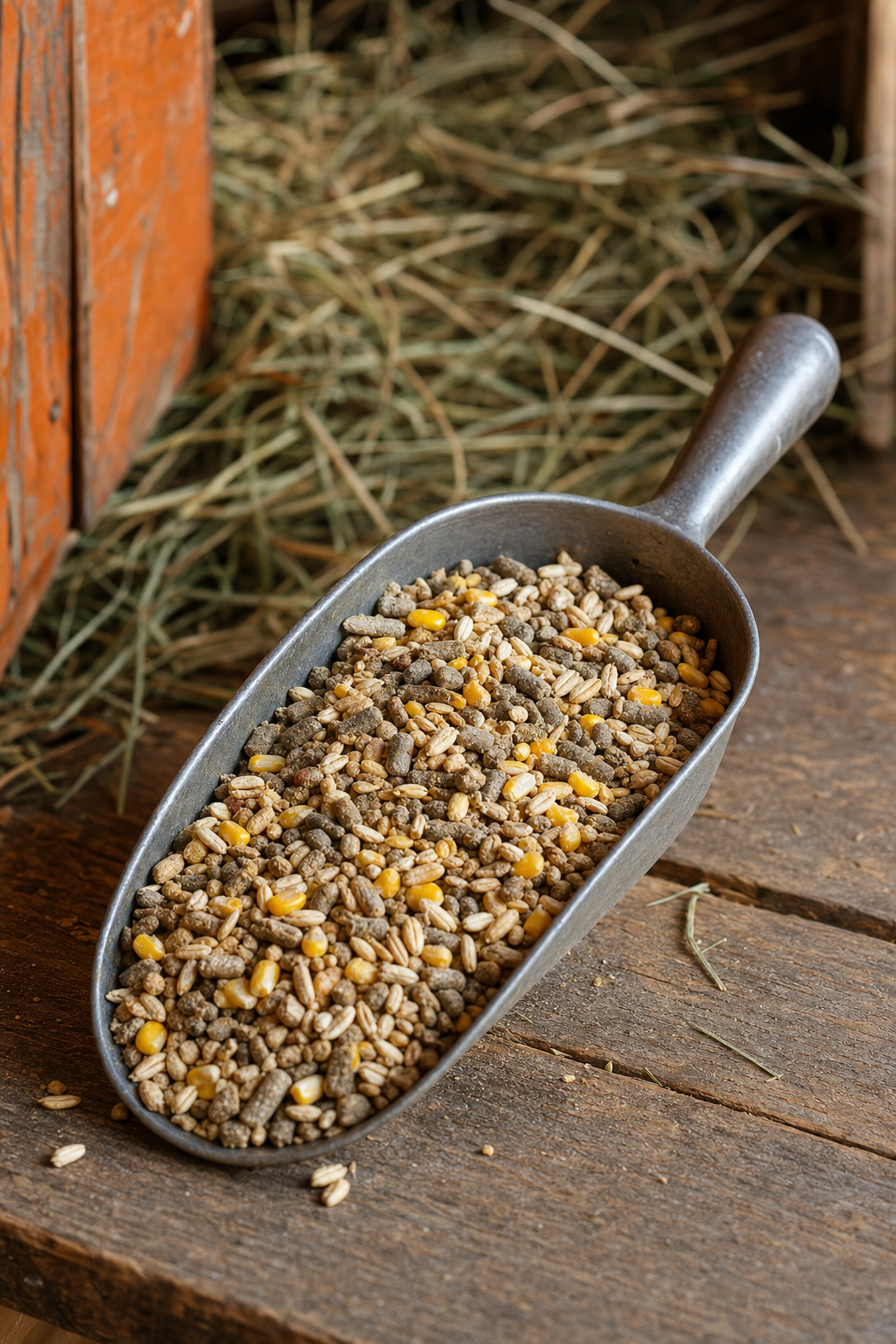
Grain gets goats into trouble faster than almost anything else. Too much grain , especially too much starch , overloads the rumen, drops the pH, and causes acidosis. From there you get laminitis, bloat, and in severe cases, death. The rule most experienced goat owners follow: grain is a supplement, not a meal.
For a healthy adult doe at maintenance, grain isn’t strictly necessary if hay and browse are adequate. For a milking doe, a pregnant doe in the last month of gestation, or growing kids, it becomes genuinely useful. The saying “grain makes milk” is widely repeated because it’s true , energy intake directly affects milk volume.
How much? A common starting point is 0.5 to 1 pound per day for an adult goat, adjusted based on body condition. Body condition scoring , running your hands along the spine, ribs, and sternum to feel fat cover , tells you more than any feeding chart. The standard scoring scale runs from 1 (extremely thin) to 5 (extremely obese), with the optimal range for goats sitting at 2.5 to 3.0. If a doe is dropping below that range in late lactation, more grain is warranted. If a wether is pushing above it, pull grain back.
Pellets are a convenient grain format, and they work well for homesteaders with small herds. Look for pellets made specifically for goats , not a multi-species product. The transparency gap in commercial goat feeds is real: in a review of commonly cited products, only one item out of seven actually disclosed its protein percentage. That was the DAIRY GOAT 500 (DG500) pelleted supplement, which lists 39% protein and is formulated specifically for lactating does. Most other products name their additives (Rumensin coccidiostat, yeast, sodium bicarbonate) without telling you the core macronutrient profile. Read labels carefully and ask your feed store for the full tag if it isn’t on the bag.
When you switch grain or introduce a new pellet, do it over two to three weeks. Start with a teaspoon-sized addition to the current feed, increasing slowly while decreasing the old. A rumen that’s adapted to one feed can get hit hard by a sudden change. This applies to any grain, not just pellets.
| Grain/Pellet Type | Best For | Key Note |
|---|---|---|
| Alfalfa pellets | Lactating does, growing kids | High calcium; limit for dry does and bucks |
| Texturized goat feed (e.g., 16% Texturized) | General herd supplementation | Often contains pelleted supplement mix |
| Pelleted goat supplement (e.g., DG500) | Lactating does needing protein boost | 39% protein; use as topper, not base ration |
| Complete pellet feed | Dry-lot situations without hay access | Check for goat-specific formulation |
| Oats | Pregnant does, young kids | Lower starch than corn; safer energy source |
| Corn | Winter energy boost | High starch; limit to avoid acidosis risk |
Step 5: Adjust rations by life stage: kids, does, and bucks
A single feeding program for the whole herd is one of the most common mistakes on small homesteads. A lactating doe, a dry doe, a growing kid, and a wether all have different nutritional needs. Feeding them identically means someone’s getting too much and someone’s getting too little.
Kids
Kids need colostrum within the first hour of life , that first milk delivers immune protection that can’t be replicated later. After that, whole milk or a quality milk replacer keeps them growing for the first weeks. Introduce good-quality grass hay as early as one week old. Getting hay into kids early develops the rumen faster.
Starter feeds for kids, like the Dairy Goat Kid Starter Feeds, contain high levels of coccidiostats. Coccidiosis is one of the most common killers of young goats, and a medicated starter is a usable defense during the first weeks when kids are most vulnerable. Avoid feeding alfalfa as the primary hay for growing kids long-term , the high calcium-to-phosphorus ratio can contribute to urinary calculi in young males.
The nutritional needs of smaller breeds like Nigerian Dwarfs follow the same principles but in proportionally smaller amounts , around half a cup to one cup of grain per adult per day, scaled up during pregnancy and lactation.
Pregnant does
Early pregnancy doesn’t require dramatic changes. But the last four to six weeks before kidding are critical. Fetal growth accelerates, the doe’s rumen capacity decreases as kids take up space, and energy demand spikes. This is when grain becomes genuinely necessary. Increase grain gradually starting about six weeks out, working up to 1 to 1.5 pounds per day by the week before kidding.
A pelleted supplement with Rumensin coccidiostat, such as the 34 R 240 Supplement w/ Rumensin, is specifically recommended for the last four weeks of gestation. Rumensin helps prevent coccidiosis in the newborn kids through the doe’s milk. Inadequate energy intake during this window can cause pregnancy toxemia, a metabolic crisis that’s hard to reverse once it sets in.
Lactating does
Peak milk production puts dairy goats on par metabolically with high-producing dairy cows, . Energy demand is at its highest. Dairy does should get grain twice daily during peak lactation, and alfalfa can be added as a hay supplement to boost protein intake. Body condition scoring every two to three weeks tells you whether you’re keeping up , a doe dropping below a score of 2.5 is burning muscle, and that affects next season’s production.
Bucks and wethers
These animals need the least supplementation. A buck at maintenance does fine on quality grass hay and free-choice minerals. Grain is only useful during breeding season when bucks lose significant condition. Wethers , castrated males , are the most at-risk group for urinary calculi, so limit alfalfa and grain strictly. Some goat owners add ammonium chloride to a wether’s feed as a preventive measure, and commercial meat goat feeds often include it. Keep the calcium-to-phosphorus ratio at 2:1 and make sure water is always available. Dehydration is the fastest path to a blocked wether.
Keeping track of which animals are getting what is easier than it sounds if you separate groups at feeding time. If your herd is mixed, consider whether the breed composition of your herd affects overall energy requirements , dairy breeds have higher maintenance needs than meat breeds, even at rest.
Step 6: Know what to avoid: toxic plants and problem foods
The idea that goats eat everything is a myth. They’re actually selective browsers who will reject things that don’t smell right. The danger isn’t that they’ll eat anything , it’s that certain plants they might sample can kill them fast.
Azalea and rhododendron are at the top of the list. These ornamental shrubs are toxic enough that even the clippings from pruning are dangerous. Don’t throw yard trimmings over the fence without knowing what’s in them. Azalea can kill a goat within minutes of ingestion.
Oak leaves come up frequently in goat discussions, often with conflicting claims. The reality is nuanced. In small amounts, oak leaves are generally tolerated and goats actively seek them out for the tannins. Large quantities , particularly fresh spring leaves or large amounts of acorns , can cause digestive upset and kidney damage over time. Let your goats browse oak freely but don’t dump piles of freshly fallen leaves into a small pen where they’ll gorge on them.
Other plants to remove from or fence off in goat areas: pine needles in large quantities, certain garden plants (tomato leaves, potato greens), and most ornamental flowering shrubs. When in doubt about a specific plant in your region, your local large-animal vet is the right call , they’ll know what’s regionally problematic and can tell you whether what’s growing on your property is a concern.
On the feed side, never use mineral or feed products made for sheep-and-goats combined, or cattle. Sheep-formulated minerals cap copper at levels that cause deficiency in goats. Cattle grain is too high-starch for goats in the amounts cattle eat it. Keep the feed room organized so you’re never accidentally grabbing the wrong bag , label bins clearly and buy goat-specific products only.
One more item that generates debate: baking soda. Offered free-choice, it helps goats self-regulate rumen pH and can reduce bloat risk when grain is part of the diet. Most goat owners offer it in a small separate container. It’s cheap insurance.
Frequently asked questions
What is the best daily feed for goats?
The best daily feed for goats is free-choice quality grass hay as the base, with loose goat-specific minerals available at all times and fresh water. For milking does, kids, or late-pregnant does, add grain at 0.5 to 1 pound per day. For adult wethers and dry does, hay and minerals alone are usually sufficient without grain. Adjust based on body condition, not a fixed schedule.
Can goats eat just grass and hay, or do they need grain?
Healthy adult goats at maintenance can do well on quality grass hay and good minerals without any grain. Grain becomes necessary for lactating does producing at high levels, does in the last six weeks of pregnancy, and fast-growing kids. Wethers and dry does generally don’t need grain and can gain unhealthy weight if fed it routinely. The exception is winter, when extra energy helps all animals stay warm.
How much hay does a goat need per day?
A good estimate is 2 to 4 pounds of hay per day for an average-sized adult goat, but free-choice feeding is more usable than measuring. Goats regulate their own intake reasonably well when hay is always available. Expect higher consumption in winter when other forage is gone and lower consumption in summer when they’re grazing or browsing actively. A bale-per-week for two to three goats is a common operational starting point.
Do goats need grain every day?
Not necessarily. Grain is a supplement for animals with improved nutritional demands , lactating does, late-pregnant does, and growing kids. Healthy adult wethers, bucks at maintenance, and dry does typically don’t need daily grain. Overfeeding grain to animals that don’t need the extra energy leads to obesity and increases urinary calculi risk in males. Let body condition scoring guide the decision, not a fixed routine.
What minerals do goats need and why does the form matter?
Goats need copper, selenium, zinc, and a range of other minerals that pasture and hay rarely provide in adequate amounts. The form matters because goats cannot absorb minerals effectively from a lick block , their tongues aren’t rough enough to pull a useful dose. Loose minerals in a separate free-choice feeder are the only format that works. Always choose a mineral formulated specifically for goats, not a sheep-and-goat blend, which limits copper to levels that leave goats deficient.
What foods are toxic to goats?
Azalea and rhododendron are among the most dangerous , even clippings can be lethal within minutes. Other plants to keep goats away from include ornamental flowering shrubs, tomato and potato plant leaves, and large amounts of fresh oak leaves or acorns. On the feed side, avoid sheep-formulated minerals, cattle feed, and any moldy hay or grain. When you’re unsure about a specific plant in your area, ask a large-animal vet before letting goats near it.
Putting it together
Build your feeding program in order: hay first, minerals always, browse whenever you can, and grain only where the animal’s life stage actually demands it. That hierarchy prevents most of the common health problems and keeps your feed costs in check. If you’re still piecing together your local supply chain for hay, feed, or a vet who actually knows goats, The Easy Homestead directory lets you search verified local suppliers and large-animal vets by ZIP code or county , find who you need, trust what you find.