Price won’t tell you which feed fits your horse. The listed feeds range from 12% to 32% protein and from 0.3% to 30% fiber.
Here are six useful options, starting with The Easy Homestead for finding local feed suppliers, then moving through balancers, whole-food rations, low-NSC feeds, and weight-gain choices.
1. The Easy Homestead
The Easy Homestead is a local directory for finding feed and seed suppliers by ZIP code or county. It’s best for horse owners who need a nearby source, especially when their usual store is out of stock or doesn’t carry a specialty ration.
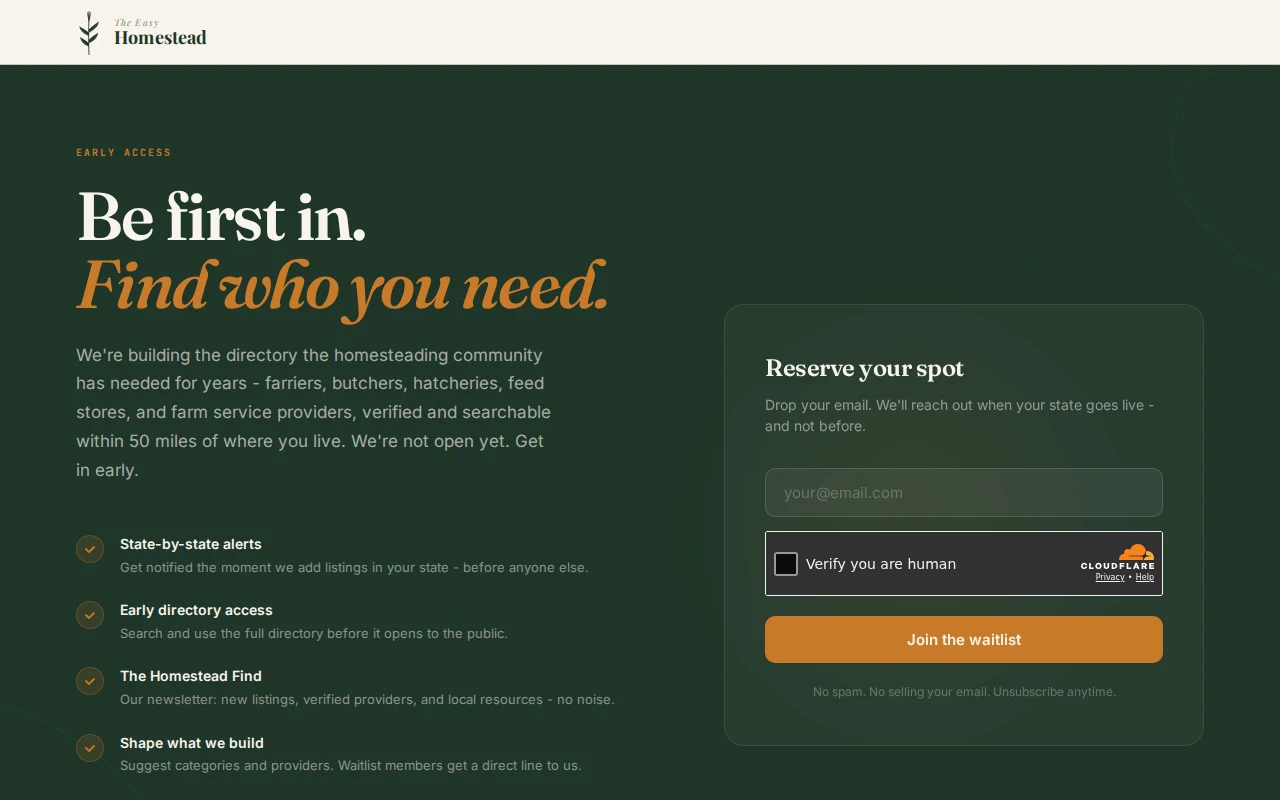
Feed choice only works when you can buy the feed consistently. A ration that fits your horse on paper becomes a poor choice if the nearest supplier is two hours away or keeps running out. The Easy Homestead helps you look for local feed and seed suppliers instead of relying on scattered social posts or word of mouth.
You can also use the directory when you need related help. A horse with weight loss may need a large-animal vet. A horse with hoof trouble may need a farrier. Those needs often surface at the same time as a feed change, so keeping local contacts in one place saves work.
Our view is plain: start with supply before you commit to a long-term feed plan. Check who stocks the feed, how far you’ll travel, and whether the supplier can keep it available. For questions about judging local stock and staff, to an animal feed store near you.
Key Takeaway: The best feed on a label is useless if you can’t source it reliably. Find the local supplier first.
2. Empower Topline Balance: For horses with lower calorie requirements
Empower Topline Balance is a diet balancer for horses with lower calorie requirements. It provides essential amino acids, vitamins, and minerals.
You can feed it alone or use it as a top-dress with SafeChoice or ProForce. Its role is targeted nutrient support rather than added calories.
As a diet balancer, Empower Topline Balance is suited to feeding plans that need essential amino acids, vitamins, and minerals without a higher-calorie ration.
Use it when your horse’s primary need is nutrient coverage and lower calorie intake. Follow the product label for feeding directions.
Pick this option when your main gap is nutrient balance rather than additional calories.
3. Crypto Aero Wholefood Horse Feed: For a complete whole-food ration
Crypto Aero Wholefood Horse Feed is a complete feed built around whole oats, hay pellets, peas, oil, flax, and dried rose hips. It’s best for owners who want a whole-food style ration with named ingredients and no added by-products listed in the research data.
The ingredient list gives you more to inspect than a vague feed description. It includes whole oats, timothy and alfalfa hay pellets, sunflower seeds, green peas, yellow peas, rice bran oil, ground flax, rose hips, cabbage, papaya, algae, yeast, anise, and fenugreek.
There is an important feeding detail here. The retailer’s product information says the feed is designed to be fed with forage and hay products, rather than as the sole ration. That means “complete feed” does not remove the need to read the full feeding directions.
The product is aimed at performance and pleasure horses. It may appeal to owners who want a ration with several plant ingredients instead of a short list built around processed feed components.
Availability can shape the decision. The cited retailer lists this item for in-store pickup only. If you live far from a stocking store, ask about supply before switching your horse. A slow transition matters more than a quick change in brand.
Choose this feed for its ingredient approach, but keep forage at the center of the plan.
4. Cavalor Fiberforce Horse Feed: For horses needing low NSC
Cavalor Fiberforce is a high-fiber, low-sugar, low-starch feed for horses that need tighter control of non-structural carbohydrates, or NSC. It’s best for horses with metabolic concerns or a history of digestive trouble, when a veterinarian supports a lower-NSC plan.
The manufacturer describes Fiberforce as a muesli with long fiber. Its ingredients include alfalfa, timothy, beet pulp, flaxseed, and digestive-support additives. The research data lists 30% fiber, which puts it at the high end of the feeds reviewed.
The manufacturer also lists 3% sugar and 5% starch on its product page. Those figures are useful because “low sugar” is too vague by itself. You need the actual label values, plus the sugar and starch in the hay and pasture your horse receives.
Fiber can support slower energy release, but it still contributes calories. A horse prone to weight gain may need careful portion control even with a high-fiber feed. The product guidance also says to feed it in several portions and after roughage.
Use this option when low NSC and fiber are the main goals. Don’t assume the product fits every horse with laminitis, insulin dysregulation, or colic history. Those cases need a feeding plan built around the individual horse.
Check the current label and feeding directions before buying.
5. Stabul 1 Equine Diets Horse Feed: For lower-calorie feeding
Stabul 1 is a low-starch, low-sugar feed with a listed calorie density of 1,100 kcal per pound. It’s best for easy keepers and horses with dietary concerns such as insulin resistance, metabolic syndrome, laminitis, or Cushing’s disease.
The product page lists less than 10% combined starch and sugar, with maximum values of 5% for each. It also lists 28% crude fiber and 12% crude protein. Those numbers make the feed a different tool from a high-calorie ration for a horse that struggles to hold weight.
Stabul 1 contains no corn, oats, or molasses. The company also says it adds no iron. That may matter when your veterinarian or nutritionist is managing the mineral profile of the whole diet.
The low calorie figure is one of the clearest data points in this comparison. That makes it easier to judge the feed’s role when calories must stay controlled.
Stabul 1 is not a shortcut around forage quality, pasture intake, exercise, or veterinary care. Make feed changes slowly. If the horse has a chronic condition, build the program with a professional rather than choosing from the bag front.
6. Nutrena Empower Boost: For hard keepers and horses in work
Nutrena Empower Boost is a supplement built around vegetable fat, flaxseed, high-fat rice bran, vitamin E, selenium, prebiotics, and probiotics. It’s best for hard keepers or horses in work that need weight maintenance and sustained energy levels.
This is a supplement intended for hard keepers and performance horses needing sustained energy levels. Its listed use makes it a targeted addition for horses with those needs.
The listed analysis gives 12% protein, and the listed price is $26. That makes the product a useful example of why price does not equal protein.
For a horse that needs weight maintenance or sustained energy during performance work, a supplement with vegetable fat, flaxseed, and high-fat rice bran may be worth considering.
Best feed for horses comparison table
The right choice depends on the job the feed must do. Protein and fiber figures are useful, but they don’t tell you whether a product is a balancer, a supplement, or a low-calorie base feed.
| Option | Best fit | Useful label data | Watch before buying |
|---|---|---|---|
| The Easy Homestead | Finding a nearby supplier | Local listings and supplier details | Coverage varies by area |
| Nutrena Empower Balance | Comparing protein and fiber | 30% protein, 0.6% fiber | Compare it with the full forage plan |
| Crypto Aero Wholefood Horse Feed | Whole-food style ration | Whole oats, hay pellets, peas, flax | Feed with forage and check local stock |
| Cavalor Fiberforce | Low-NSC, high-fiber feeding | 30% fiber, 3% sugar, 5% starch | Match it to the full forage plan |
| Stabul 1 | Lower-calorie feeding | 1,100 kcal/lb, 28% fiber | Use professional guidance for medical cases |
| Nutrena Empower Boost | Hard keepers and horses in work | 12% protein | It is a supplement for a balanced diet |
NSC means non-structural carbohydrates, mainly sugars and starches that can affect blood glucose and insulin response. A low-NSC feed database can help you compare labels, but your horse’s full diet still matters more than one bag.
The average was $19.83. Those figures are useful for a rough comparison, not a daily feeding cost, because serving rates differ.
Pro Tip: Write down your horse’s current body condition, hay source, pasture access, workload, and feed amount before switching. Review the same notes after the change.
FAQ about the best feed for horses
What is the best feed for horses that need to gain weight?
The best feed for weight gain depends on why the horse is thin. Nutrena Empower Boost is aimed at hard keepers and horses in work, while a high-fat, high-calorie feed may suit a horse needing a larger calorie increase. Check teeth, hay quality, workload, and health before adding calories.
What is the best feed for horses with insulin resistance?
A low-sugar, low-starch feed is often considered for horses with insulin resistance, but the full diet matters. Cavalor Fiberforce is described as an ultra-low-NSC blend, while Stabul 1 is described for horses with laminitis, colic, or Cushing’s. Your veterinarian should help set the plan, especially if the horse has laminitis or another metabolic condition.
Is a ration balancer better than regular horse feed?
A ration balancer is better when your horse needs vitamins, minerals, and amino acids without many extra calories. Empower Topline Balance fits that role and can be fed alone for horses with lower calorie requirements or used as a top-dress with SafeChoice or ProForce. It may not suit a horse that needs more energy or fiber. Compare the balancer with your hay analysis and body-condition goal.
Does expensive horse feed have more protein?
Expensive horse feed does not always have more protein. Nutrena Empower Boost is listed at $26 and 12% protein.
How do I find a horse feed supplier near me?
You can find a horse feed supplier near you by searching local listings by ZIP code or county. The Easy Homestead helps you look for feed and seed suppliers in your area. Confirm stock before making a long trip, especially when your horse needs a specialty low-NSC feed.
Conclusion
Choose the feed that matches the horse’s job, not the highest price or biggest protein number. Start with forage and health needs, then confirm that you can buy the feed regularly. When supply is the problem, search The Easy Homestead for a local feed supplier near you.