Finding farm equipment rental near you sounds simple until you spend two hours on hold, get quoted a commercial rate for a one-day job, or discover the only excavator in the county is booked out three weeks. Here are six options that actually work for homesteaders, from a searchable local directory to a rental provider with a design built for tight spaces around structures.
1. The Easy Homestead — best starting point for finding local rental equipment and services
The Easy Homestead is a local directory built for the homesteading supply chain. Think of it as a Yelp built specifically for working farms and rural properties, with verified listings you can search by ZIP code or county. It covers the service providers and suppliers that no general directory touches: farriers, mobile farm services, feed and seed suppliers, large-animal vets, and fencing and farm construction contractors.
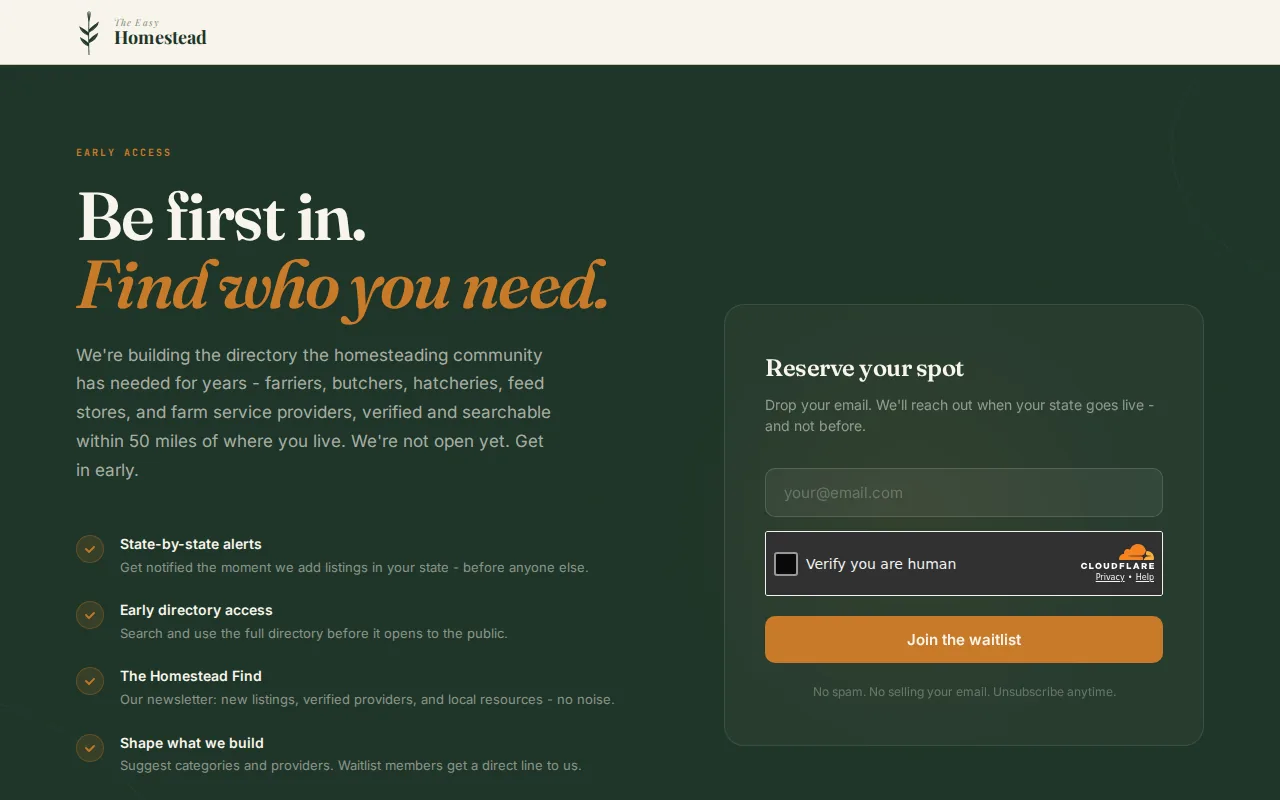
For equipment rental specifically, the directory connects you to local contractors and service providers who bring equipment to the job, often a better option than renting a machine you’ve never operated. If you need a post hole dug, a field leveled, or a trench run, finding the right local operator through a verified directory saves more time than hunting down a rental chain that doesn’t know your county.
The search-by-ZIP feature is the real differentiator. When you’re on 12 acres outside Knoxville and need someone this week, you don’t want results from three states away. The Easy Homestead surfaces providers in your actual area, shows real reviews, and filters by category so you’re not starting from a blank Facebook thread and hoping someone answers.
It also fills a gap that LocalHarvest and EatWild leave wide open. Those platforms index farms and food, but they don’t cover trades and services. If you need someone with a skid steer or a tractor with a loader, a food-only directory won’t help. The Easy Homestead was built around the full supply chain, including the service side.
Coverage varies by region since the directory is still building out listings in some areas. If your county is thin, you can still browse adjacent counties or flag your area so providers know there’s demand. That gap is worth naming, because overpromising on coverage would be worse than being straight about it.
If you’re also sorting out other farm logistics at the same time, the directory covers more than equipment. You can find a large animal vet near you in the same search session, which matters when you’re adding goats or managing pigs through processing season.
Key Takeaway: The Easy Homestead is the right first stop because it surfaces local operators who come to you with equipment, not just a machine you haul home and figure out yourself.
2. Merz Farm Equipment — zero tail swing rentals for tight farm layouts
Merz Farm Equipment is the only provider we found in our research that specifically advertises a zero tail swing design as a selling point for homeowners. That detail matters more than it sounds. A standard excavator swings its counterweight out past the machine’s footprint when it rotates. Near a house wall, a fence line, or a raised bed garden, that swing can hit something expensive. The zero tail swing design keeps the counterweight inside the machine’s track width, so you can work close to structures without damage.
Their rental lineup includes skid steer, excavator, post hole digger, leveler, rock bucket, grapple, trencher, vacuum, power rake, and plate compactor. That’s a wide range for a single local provider. Most homestead jobs, from digging a pond edge to setting fence posts to clearing brush, have a machine on that list.
The caveat is real friction: booking is by phone only, and the company doesn’t publish service area or pricing online. You have to call to find out if they cover your county and what a day rate looks like. For a homesteader who’d rather confirm everything in writing before committing time to a phone call, that’s a drawback worth knowing upfront.
For experienced homesteaders who need equipment occasionally rather than a commercial operation running machines every week, the zero tail swing feature is a practical differentiator. If you’re working close to your house and outbuildings, that design alone makes this worth the phone call.
Zero tail swing machines were developed specifically to address jobsite constraints in confined spaces, a design choice originally driven by urban construction but now increasingly relevant for rural residential and agricultural work near structures.
3. Independent local equipment dealers — often cheaper and more flexible than national chains
Independent dealers, the kind with a gravel lot, a handful of machines, and an owner who answers the phone, often beat national chains on both price and flexibility. They’re not managing a franchise pricing model, so day rates and weekend rates can be negotiated. They also tend to know the equipment well enough to explain quirks specific to their machines before you haul one home.
The best way to find them is through your county’s extension office, the local feed store bulletin board, or by asking at a farm supply co-op. These dealers rarely show up in Google search because they don’t invest in SEO. But they’re real and they’re operating, often for decades. Word of mouth is their whole marketing strategy.
When you do find one, ask specifically about the implements that come with the machine. A tractor rental is almost useless without the right attachment for your job. A good independent dealer will have a bush hog, a box blade, a tiller, and possibly a loader bucket all available for the same machine, and they’ll often include one or two implements in the base rate rather than charging per attachment.
The downside is inconsistency. Equipment condition varies, maintenance records are informal, and availability depends entirely on who else called that week. If you have a hard deadline, a national chain with a reservation system is more reliable. But if you’re flexible on date and want a fair rate from someone who’ll walk you through the machine in the yard before you leave, an independent dealer is hard to beat.
If your project involves soil prep after grading or land clearing, it’s worth pairing equipment rental with a local farm soil testing service so you know what you’re working with before you start moving dirt around.
Pro Tip: When calling an independent dealer, ask what the machine last had done on it and when. A dealer who knows the answer without hesitating is one who’s actually maintaining the fleet.
4. Agricultural co-op and member rental programs — discounted access for dues-paying members
Many agricultural co-ops and member organizations run or partner with equipment rental programs that give members access to reduced rates. State-level chapters often negotiate member discounts with regional equipment dealers and rental operations, coordinating benefits across their networks.
The structure varies by state. Some co-ops run their own equipment pools. Others have formal discount agreements with existing rental operations in the area. A few have co-op arrangements where members share equipment owned collectively by the chapter. Program offerings change annually, so calling your county chapter directly is the only way to know what’s current.
Dues for membership are low relative to the savings on a single equipment rental. If you’re renting a machine even once a year, the math tends to work out. The membership also gets you access to agronomist advice, legal resources for farm property questions, and lobbying representation on issues that affect small landowners.
The limitation is that programs are uneven. A county chapter in a rural, agricultural-heavy area is likely to have more equipment resources than a chapter in a semi-rural exurb. And if the chapter near you is small, the equipment pool may be limited to basic items like tillers and trailers rather than excavators or skid steers.
If you’re also managing livestock alongside your land projects, the co-op connection can help with more than equipment. It’s one of the legitimate places where you can ask who the local large animal vets are, who handles farm-call shearing, and who the reliable butchers are in the county network.
5. National rental chains — wide inventory, reliable availability
When you need to confirm a machine is available on a specific date, national chains are the most reliable option. Many large national rental chains now offer real-time delivery tracking so you know exactly when equipment will arrive on site, and their online catalogs let you browse inventory, add to cart, or request a quote without a phone call. You can choose in-store pickup or round-trip delivery, and extending a rental is as simple as calling to request more time.
The larger national networks operate with online reservation systems and broad equipment categories. These companies maintain their machines to a consistent commercial standard, which means you’re less likely to get a machine with a dead hydraulic line or a cracked bucket pin than you might be with a smaller operation.
The trade-off is price and scale mismatch. National chains price for commercial contractors who are billing the rental cost to a client. A homesteader renting for a single half-day job is paying a commercial day rate that doesn’t flex much. Delivery fees can also add up fast in rural areas where the nearest depot is 40 miles out. And the staff at the counter, while professional, are trained on a catalog of hundreds of machines, not specifically on the attachments that matter for your specific homestead task.
For projects with a fixed schedule, a hard completion date, or a scope large enough that machine downtime would be costly, national chains are the right call. If you’re grading a driveway before winter or installing a drainage system before a wet season, book the machine you need through a national chain and know it’ll show up when they say it will.
6. Neighbor-to-neighbor equipment sharing — Facebook Marketplace, local co-ops, and land trusts
Peer-to-peer equipment sharing is the informal layer that fills gaps between formal rental options. On Facebook Marketplace, searching your county for specific equipment terms, “tractor rental,” “mini excavator,” “skid steer day rate,” often surfaces neighbors willing to rent their machine for a flat fee. The rates are typically well below commercial pricing because the owner is just covering wear, not running a business.
Local agricultural co-ops sometimes maintain shared equipment pools as a member benefit. This tends to be informal, often just a list of members who have equipment and are willing to share it at cost. If your area has a working ag co-op, it’s worth asking specifically about equipment availability at any member meeting.
Land trusts and conservation organizations occasionally have equipment available for properties they manage or for adjacent landowners working on conservation-related projects like pond restoration, native planting, or erosion control. It’s a niche route, but if your project has a conservation component, it’s worth a call to your county’s land trust or soil and water conservation district office.
The risks with peer-to-peer are real. No formal rental agreement means no clear liability framework if something breaks or someone gets hurt. Equipment condition is unverified. And the informal nature means the machine you confirmed last week may not be available when you show up. If you go this route, have a backup plan and get the terms in writing, even a simple text thread confirming date, rate, and condition.
For homesteaders who want a more reliable way to find local operators and avoid the Facebook thread loop, searching The Easy Homestead directory by county is a faster path to verified providers than scrolling Marketplace listings with no reviews or accountability.
What to check before you rent any piece of farm equipment
Before you commit to a machine and a date, a few questions determine whether the rental will go smoothly or sideways. This checklist applies whether you’re renting from a national chain or a neighbor down the road.
| Check | Why it matters | Red flag |
|---|---|---|
| Equipment condition and hours | High-hour machines break more often; a breakdown mid-job wastes your rental time | Owner can’t tell you the machine’s hours or last service date |
| Attachments included in rate | A tractor or skid steer without the right attachment is useless for most farm tasks | Attachments are per-item add-ons that double the cost |
| Delivery coverage and fee | Rural properties can be far from the nearest depot; delivery adds cost and time | Delivery fee not quoted upfront; rural surcharge applied at checkout |
| Operator requirement | Some equipment requires a licensed or certified operator; renting without one creates liability | No mention of operator requirements for excavators or lifts |
| Damage liability and insurance | Who pays if the machine damages a fence, utility line, or structure on your property | Rental agreement puts all liability on you with no damage waiver option |
| Fuel policy | Return-full vs. return-empty policies vary; misunderstanding adds charges at return | Fuel policy not in the written agreement |
| Minimum rental period | Many operations have a half-day or full-day minimum; a two-hour job still costs a full day | Minimum period not disclosed until pickup |
On the liability point specifically: federal operator safety standards cover many pieces of equipment you’d rent for farm use, including skid steers and forklifts. Knowing what operator requirements apply before you rent saves you from a situation where you’re running a machine without meeting the training threshold the rental agreement quietly requires.
If your project sits at the edge of your own land and a neighboring parcel, it’s also worth confirming property lines before you start moving dirt. A quick soil and survey check pairs well with the land prep phase. If you’re also planning livestock setup on the same property, the same logistical window where you have equipment on site is often the right time to think about fencing and pasture layout, which is where connecting with a fencing contractor through a directory like The Easy Homestead saves a second round of scheduling.
When homesteaders share what they wish they’d known before a first major equipment rental, two things come up most: not asking about attachments until the day of the job, and not reading the damage clause before signing. Both are fixable with five minutes of questions before you confirm the booking. If you’re also sourcing hay for the new pasture you’re grading, our guide on where to buy hay near you covers local sources worth checking while you have the logistics window open.
FAQ
What is the cheapest way to rent farm equipment near me?
Neighbor-to-neighbor sharing through Facebook Marketplace or a local ag co-op typically has the lowest rates because the owner is covering wear, not running a rental business. Independent local dealers are usually cheaper than national chains for single-day jobs, especially if you pick up and return the equipment yourself rather than paying delivery.
Do I need a license to rent and operate farm equipment?
It depends on the machine. Most agricultural tractors and skid steers on private property don’t require a license in the US, but some equipment, particularly compact track loaders and telehandlers, may trigger operator training requirements under OSHA standards when used in certain settings. Always read the rental agreement carefully and ask the dealer before signing. Operating outside the agreement’s terms can void any damage coverage.
How far in advance should I book farm equipment rental?
For national chains in rural areas, two to four weeks ahead is safe for most seasonal busy periods (spring land prep, fall harvest cleanup). Independent dealers and neighbor-to-neighbor arrangements can sometimes turn around same-week or even same-day. If your project has a weather-sensitive window, book earlier than you think you need to and ask about the cancellation policy before you commit.
What equipment do I actually need for a basic homestead project?
A skid steer with a bucket handles most moving and grading jobs on a small property. Add a grapple attachment for brush clearing. A mini excavator is better for trenching or digging close to structures, especially with zero tail swing if you’re near buildings. A post hole digger attachment on either machine handles fence post installation faster than a standalone auger. Match the machine to the specific task rather than renting the biggest thing available.
Can I find farm equipment rental listings on The Easy Homestead directory?
The Easy Homestead directory lists local service providers and suppliers for the homesteading supply chain, including fencing and farm construction contractors who bring their own equipment to jobs. Search by ZIP code or county to find verified providers near you. For rental-only listings, use the directory alongside the options in this guide to triangulate what’s available in your specific area.
What’s the difference between renting equipment and hiring an operator?
Renting equipment means you operate the machine yourself. Hiring an operator means a professional runs it and you pay for their time plus machine use, often called a “wet rental” in the industry. For homesteaders without experience on heavy equipment, hiring an operator is worth the added cost. You avoid liability, finish faster, and don’t spend half the rental day learning controls on a machine you’ll use once.
Conclusion
For most homesteaders, the fastest path to the right equipment starts with knowing what your local options actually are. The Easy Homestead directory is built exactly for that: search by county, find verified local contractors and service providers, and skip the three-week research project. If you know the machine you need and want to rent it yourself, Merz Farm Equipment (call ahead) and independent dealers in your county all have real equipment available. Pick the option that matches your timeline, your budget, and how confident you are running the machine. Find a verified local equipment operator or farm service provider near you on The Easy Homestead.