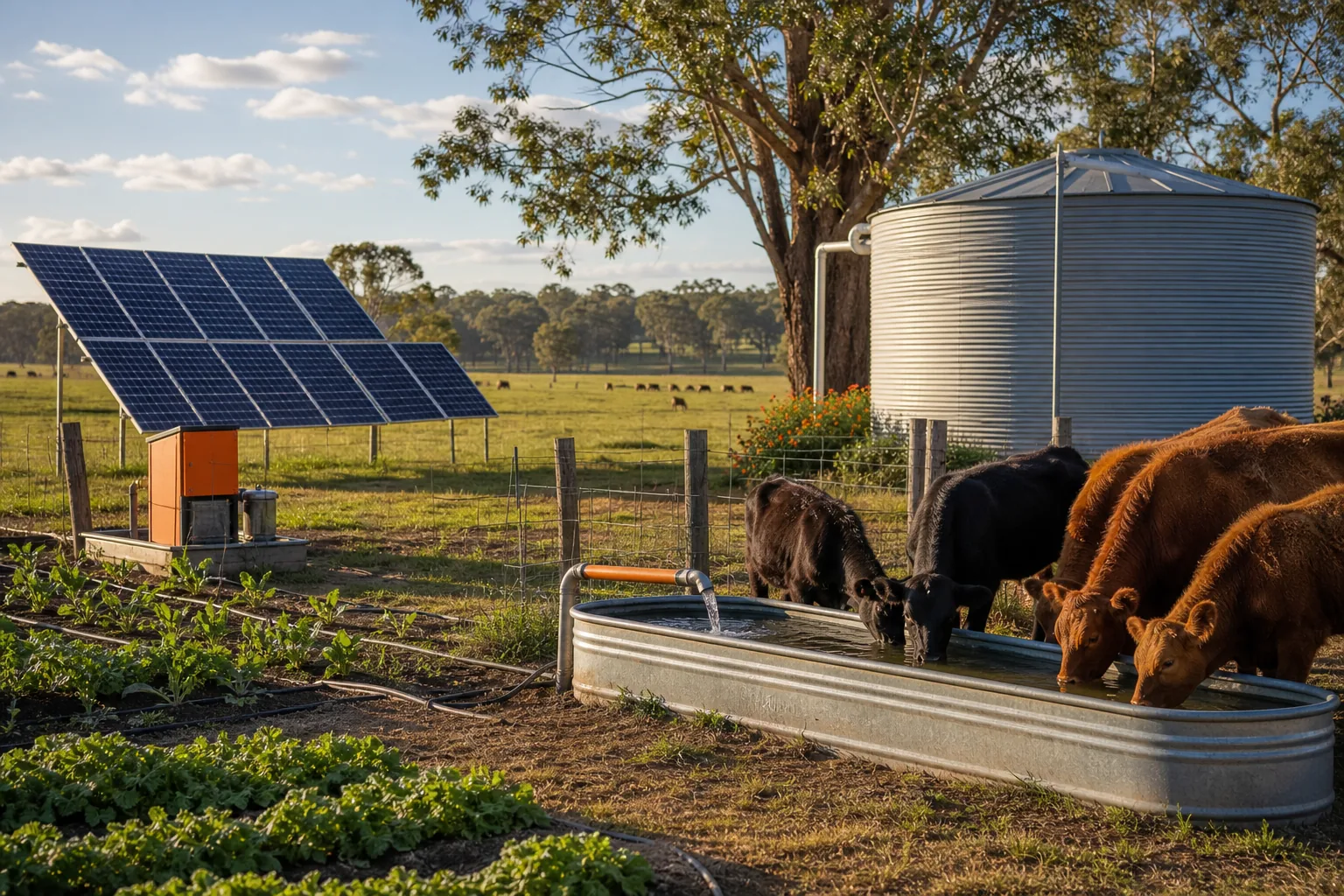
A bigger flow rate doesn’t always need a bigger solar array. Lift, also called head, often drives the panel size. A pump pushing water 300 feet uphill can need far more power than a low-head pump with a similar flow rate. To size your system, work through water demand, total dynamic head, flow, pump curve s, and power storage in that order.
Published specs for 7 solar well pump kits from 3 manufacturers, RPS, Lorentz, and VEVOR, show how the numbers move together. RPS panel wattage rises 4x, from 200 watts to 800 watts, as listed max head climbs from 125 feet to 300 feet. Zero-head flow over that same span grows only from 5.1 GPM to 8.9 GPM, a 1.7x increase. Lorentz’s PS2-4000 needs 4.0 kW at 140 meters of head, versus 0.7 kW for lower-head PS2-600, confirming head drives panel size more than flow.
Step 1: Calculate how much water your homestead needs
To learn how to size a solar water pump for a homestead, start with daily water volume. Write down every job the pump must handle, then estimate the gallons used by each one.
Separate steady demand from short bursts. A drip system may run for hours at a low rate. A stock tank may need a fast refill after several animals drink. Household use creates another demand pattern, especially when laundry or showers run at the same time.
Make a daily worksheet with these lines:
- Livestock watering
- Garden or orchard irrigation
- Household water
- Cleaning and wash-down
- Tank refill and reserve volume
Add the gallons for each line. Then decide how much of that water must move during the sunniest part of the day. A storage tank can let a smaller pump run longer. Without storage, the pump must meet the highest demand while the system has usable sunlight.
Do not size from an average day if your animals or crops need water during a hot spell. Use your peak day instead. A homestead with goats, pigs, laying hens, and a large garden may need more water during summer than it does during spring rain.
Water source reliability matters too. A well, pond, spring, cistern, or hauled tank each has a different risk. RPS explains solar pump sizing in terms of total water required each day, pressure, and vertical lift. That matches the order you should use on your worksheet.
Key Takeaway: Size for the busiest day you expect, then use storage to smooth out demand when possible.
Our guide to rainwater collection system cost options can help if a cistern or tank will supply part of your pump system. The tank is often the difference between a pump that runs at a steady rate and one that must chase every demand spike.
Record the final daily volume in gallons. Keep the largest hourly demand separate. You will use both numbers later.
Step 2: Measure total dynamic head from the source to the outlet
For solar water pump sizing, total dynamic head is the number that turns a rough idea into a pump specification. It includes vertical lift plus the pressure and pipe losses the water faces on the way out.
Measure the vertical distance from the lowest water level at the source to the highest outlet. Use the lowest seasonal water level, not the level you see after rain. For a well, include the water level and the outlet height. For a pond or cistern, measure from the pump intake to the tank inlet or watering point.
Next, account for the pressure needed at the outlet. Pressure converts to head at roughly 2.31 feet of water for each psi. A system that needs 40 psi at a hose bib therefore needs about 92 feet of pressure head before you add elevation and pipe friction.
Use this working formula:
Total dynamic head = static lift + pressure head + friction head.
Static lift is the vertical rise. Pressure head is the pressure needed at the outlet. Friction head comes from pipe length, narrow pipe, bends, valves, filters, and fittings.
Count the full pipe run. A pump may sit close to the source while the outlet sits hundreds of feet away. That long run can reduce the flow you actually get. Small pipe creates more loss, so do not assume the pump’s outlet size should dictate the whole system.
Measure the highest point if the water must climb a hill. A tank placed above the garden may need less booster pressure at the field, but it still needs enough head to fill the tank. An elevated tank can then provide pressure by gravity.
Write down two head values if your system has two jobs. You might fill a high tank at one head and feed a low-pressure drip line at another. The pump curve must meet the harder operating point, or you must split the system into zones.
Pro Tip: Measure head during the dry season and include the highest outlet. A wet-season measurement can leave you short when the source drops.
By now you should have a daily gallon target, a peak flow target, and a total dynamic head estimate. Those three numbers are the basis for comparing pumps.
Step 3: Set the flow rate and match the pump curve
When sizing a solar water pump, choose the flow rate after you know the head. A pump’s advertised maximum flow is not the flow it will deliver at your actual lift.
Start with the job. If you need to move 600 gallons into a tank during a five-hour solar window, the pump must average 2 gallons per minute. That is a daily average, not always the pump’s best operating point. Add room for cloudy periods or run the pump for more hours when the sun is available.
Then read the pump curve. Find your total dynamic head on the vertical axis and trace across to the pump curve. The point where they meet shows the expected flow. If the curve does not reach your head, the pump is too small. If the pump reaches the head but the flow falls below your target, choose a different pump or reduce the lift and friction.
Flow data can be thin on product pages. The Shurflo 3.5gpm 12V Pump lists a maximum flow of 3.5 gallons per minute. The Seaflo 55 Series Diaphragm Pump lists 5.5 gallons per minute. Those figures do not tell you what either pump will deliver at a high head.
The available examples show why the name on a pump can mislead you. The RPS 800 is documented with a maximum head of 300 feet and an 800-watt panel recommendation. A low-head AquaJet Medium Output example lists a 6.9-foot head with a 20-watt panel recommendation. The panel gap follows lift far more closely than the name or headline flow figure.
For a low-head tank system, a modest 12-volt pump may work well. One documented Shurflo setup pairs the pump with a 100-watt solar kit and a 100Ah 12V marine battery. That example is useful because it gives flow, panel, and battery details in one place. Many other product listings leave one or more of those fields out.
Watch the video below for a visual look at a small off-grid pump setup. Treat it as an example, not a substitute for your own head and flow measurements.
Compare the full operating point instead of relying on a product name. The PS2-100 AHRP-23S is listed for irrigation with a 200-watt panel recommendation.
Ask the seller for the pump curve at your voltage. Also ask for power draw at your head. Without those numbers, you are guessing at both panel size and daily output.
Step 4: Size the solar array, controller, and battery bank
To finish sizing a solar water pump for a homestead, match the array to the pump’s power draw at its working head. Do not size panels from the pump’s maximum flow alone.
Use the manufacturer’s watt draw if it is available. If the pump uses 300 watts while running, your array must supply that load during the useful solar window. Add a margin for heat, wiring loss, dirt, clouds, and imperfect panel angle. The exact margin depends on the kit and your site, so use the controller or pump maker’s stated requirement when available.
The RPS 800 example calls for an 800-watt panel setup at a documented maximum head of 300 feet. The Shurflo example uses a 100-watt kit for a lower-head system. These are not competing answers. They serve different lift and pressure needs.
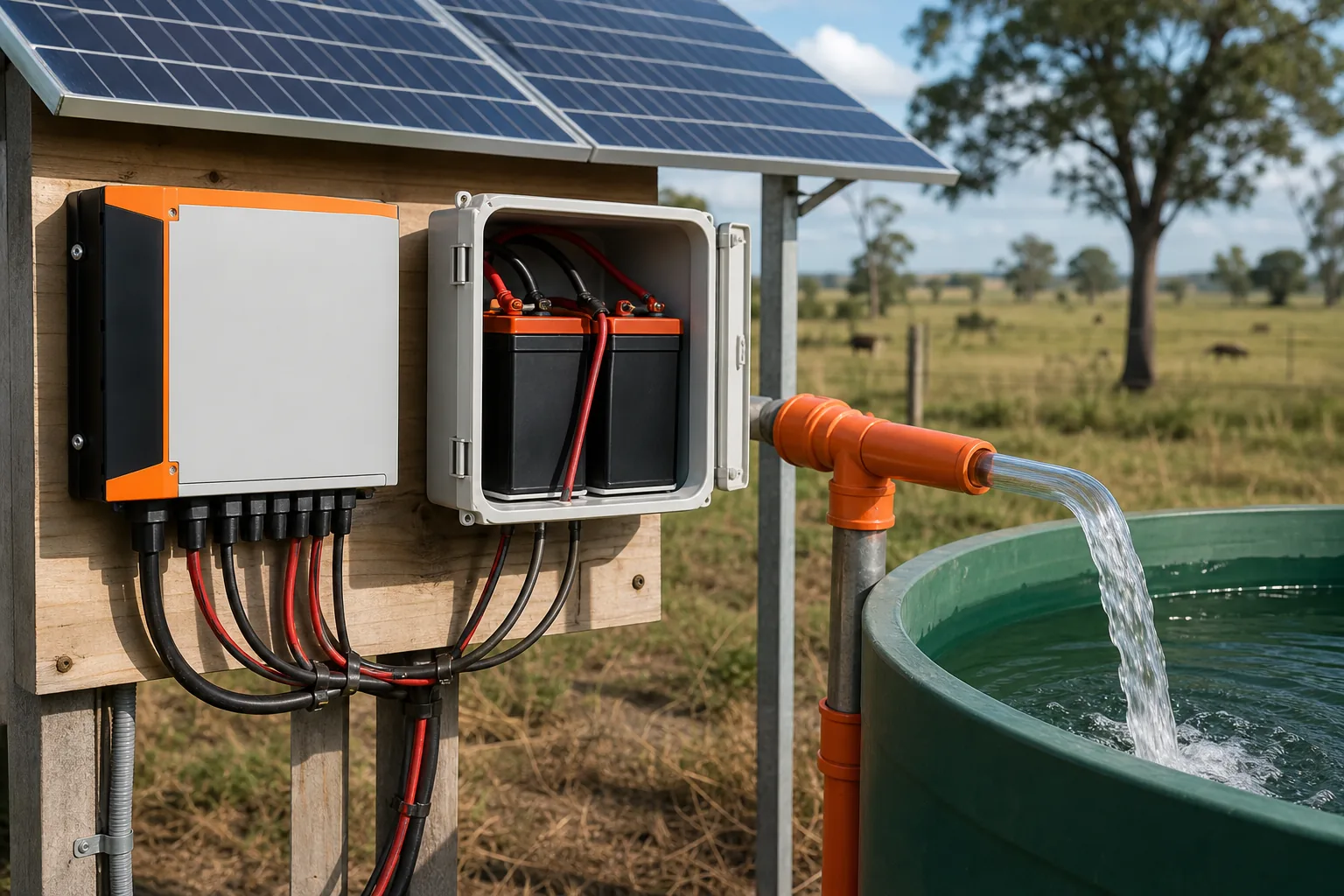
Choose a controller that matches the panel voltage, battery voltage, and pump motor. A solar pump controller or linear current booster can help the pump start and run as sunlight changes. Make sure the controller includes the protections your system needs, such as low-water shutoff or dry-run protection.
Battery sizing depends on when the pump must run. A direct solar system can fill a tank during daylight and skip night operation. A pressure pump serving a house may need battery power after sunset. In that case, calculate pump watts multiplied by hours of night operation. Then account for the battery chemistry, usable depth of discharge, temperature, and inverter or wiring losses if the pump does not run directly on DC.
Battery data is missing for most of the example pumps. Only the Shurflo setup lists a 100Ah 12V marine battery. That gap matters. You cannot promise night-time runtime from panel watts alone.
For a broader look at panel and battery choices, compare these solar panel kits for homestead power after you know your pump’s voltage and load. A kit that works for lights may not start a motor.
Protect the system from common field problems. Put the controller and battery in a dry, ventilated enclosure. Keep wiring runs short where possible. Add a fuse or breaker sized for the circuit. Protect exposed pipe from freezing and shield the pump intake from sediment.
 Save
Key Takeaway: Panel watts cover the pump’s work during sunlight, while battery capacity covers the hours when sunlight cannot.
Step 5: Check the final size against real homestead use cases
The final check for solar water pump sizing is a live-use test. Compare your calculated system with the way water moves on your property each day.
Use the table below as a decision screen. It does not replace a pump curve, but it shows which number deserves the most attention in each case.
| Homestead use | Main sizing pressure | What to verify | Common mistake |
|---|---|---|---|
| Livestock troughs | Daily gallons and refill speed | Peak herd demand, source recovery, tank float valve | Sizing for one animal instead of the full group |
| Garden drip lines | Low flow over long run time | Required pressure, zone flow, filter loss | Using a high-flow pump without checking pressure |
| Orchard irrigation | Head plus zone size | Elevation, pipe length, emitter pressure | Running every row at once |
| Household storage tank | Tank fill time | Daily gallons, fill height, overflow control | Skipping reserve volume |
| House pressure system | Night runtime and pressure | Battery capacity, pressure switch, cycling | Using panel watts as the night-time power plan |
For livestock, a storage tank can reduce the need for a high instantaneous flow rate. The pump fills the tank when sunlight is available, and the float valve handles demand at the trough. For irrigation, split large fields into zones when the required flow exceeds what the pump can provide at the measured head.
For household pressure, consider a separate booster pump after the storage tank. A well pump that fills a tank does not automatically make a good pressure pump at the house. The two jobs have different flow cycles and pressure needs.
Run a failure check before buying. Ask what happens if the well level falls. Ask whether the controller stops the pump when the tank is full. Ask what parts you can replace on site. Also ask for the power draw at your exact head, not only the motor’s maximum rating.
The manufacturer’s solar pump comparison page shows why a complete kit list matters. Components, sensors, wiring, and support can affect the install as much as the pump itself. Read the list closely and mark every item that is included or missing.
Before you commit, get a second set of eyes on the measurements. The Easy Homestead can help you look for local farm suppliers, pump installers, fencing crews, and other service providers by county or ZIP code. Coverage varies by area, so verify that a listing serves your property before you plan around it.
If you cannot get a clear pump curve, power draw, and battery recommendation, pause the purchase. A lower-cost pump with missing data can cost more once it fails to meet the head or daily volume.
FAQ
How many watts do I need for a solar water pump?
The required watts depend mainly on head, flow, pump efficiency, and daily run time. A low-head system may use a 100-watt-class array, while the documented RPS 800 example recommends 800 watts for up to 300 feet of head. Use the pump curve and stated power draw at your operating point.
How do I calculate solar pump head?
Calculate solar pump head by adding vertical lift, pressure head, and pipe friction. Measure from the lowest water level to the highest outlet. Convert needed pressure at about 2.31 feet of head per psi, then add losses from pipe, fittings, valves, and filters.
Can a 100-watt solar panel run a water pump?
A 100-watt panel can run some low-head, low-flow water pumps when the pump and controller support that load. The Shurflo example pairs a 3.5 gallons-per-minute pump with a 100-watt kit and a 100Ah battery. It will not automatically suit a deep well or high-pressure irrigation system.
Do I need a battery for a solar water pump?
You need a battery if the pump must run after sunlight fades or if you need steadier power during changing conditions. You may skip the battery when the pump fills a storage tank only during daylight. Size the battery from pump watts, night hours, usable capacity, and temperature.
What is more important, pump flow or head?
Both matter, but head often drives the solar array size. A pump must deliver your required flow at your measured total dynamic head. A high maximum flow figure means little if the pump loses most of that flow while pushing water uphill through long pipe.
Conclusion
Measure your peak daily gallons and total dynamic head before you shop for a pump. Then choose a model with a published curve, power draw, controller requirement, and battery plan at your operating point. If you need local help checking suppliers or installers, search The Easy Homestead by county. Find a verified farm service near you and compare the details before you buy.