Most mobile butchers don’t have a website. They’re booked by word of mouth, listed nowhere online, and full until next fall. But they’re out there. Here are seven ways to actually find one near you , ranked by how fast they’ll get you a real answer.
1. The Easy Homestead — verified mobile butcher listings by ZIP code and county
The Easy Homestead is a local directory built specifically for the homesteading supply chain. Think of it as a Yelp for the people and services that working farms actually need. Mobile butchers and meat processors are one of the core listing categories.
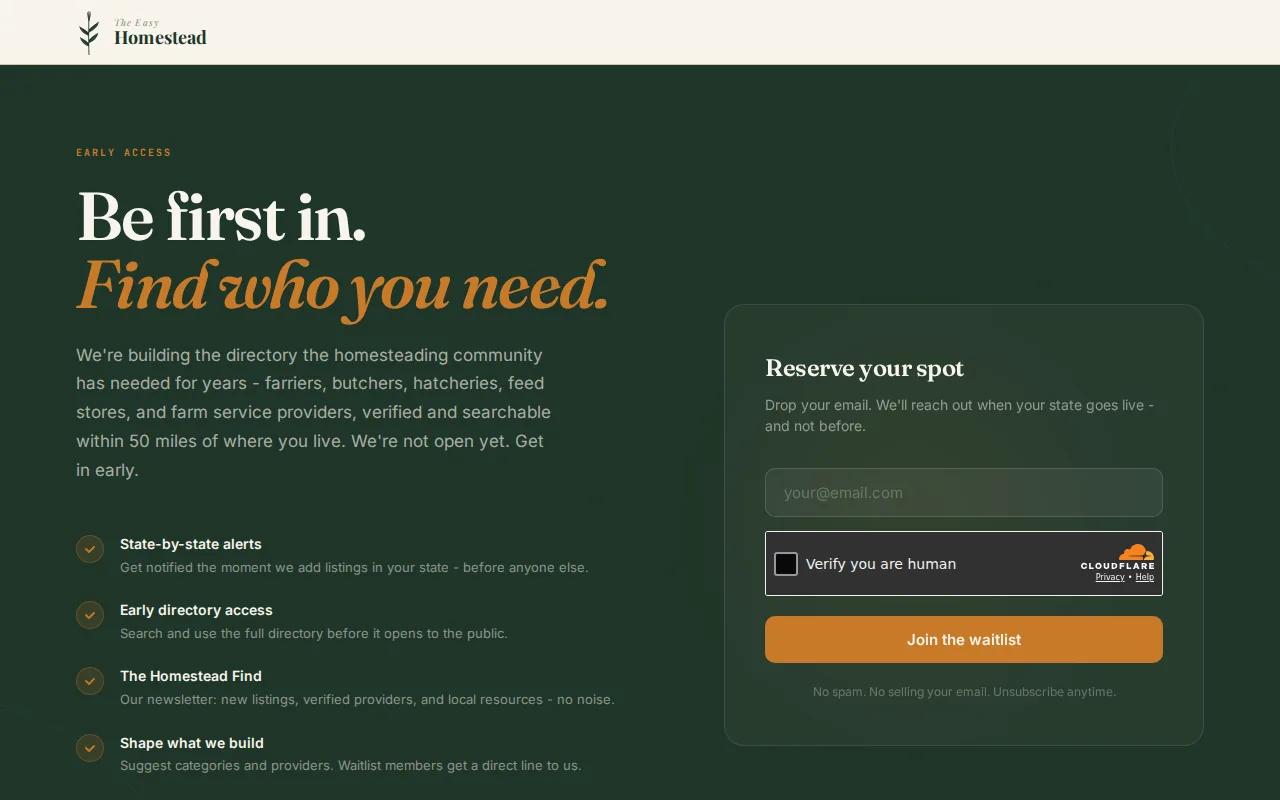
Search by ZIP code or county and you’ll get verified listings with real reviews. Not a Facebook thread with twelve opinions and no consensus. Actual profiles for licensed processors who have been confirmed as real businesses operating in your area.
Here’s why this matters if you’re raising pigs or cattle: most of the search traffic for processing help ends up on forums or state agriculture pages that haven’t been updated in years. The Easy Homestead pulls that information into one searchable spot and adds a review layer on top, so you can see what other homesteaders in your county said about the booking process, the cut quality, and whether the operator showed up on time.
The directory covers mobile units specifically, not just fixed-location plants. So if you need someone to come to your property for on-site slaughter rather than hauling animals to a facility, you can filter for that. For anyone raising animals for the first time and trying to understand the difference between state-inspected and USDA-inspected processing, the guide to finding a meat processor near me on the blog breaks that down clearly before you start calling around.
Coverage is strongest in areas with active homesteading communities. If your county has thin listings right now, submit a listing request for your local processor and we’ll verify and add them. The directory grows with the community.
Key Takeaway: The Easy Homestead is the only proximity-searchable directory with verified listings and real reviews for mobile butchers , start here before you dig into state agriculture pages or Facebook threads.
2. Your state’s department of agriculture processor list — free and regularly updated
Every state with a meat inspection program maintains a public list of licensed processors. This includes mobile slaughter units in most states. The list is free, updated regularly by the state ag department, and it’s the most legally reliable source you have for confirmed-licensed operators.
Search for “[your state] department of agriculture meat processor list” or “[your state] licensed meat processors directory.” You’ll usually land on a PDF or a searchable database. Some states break it out by county. Others require you to download the full list and scan it yourself.
The upside: every operation on the list has a current license. You’re not taking someone’s word for it on Facebook. The downside: there’s no review layer. You’ll see a business name, a contact, and a license type. Whether they’re actually good, currently taking new clients, or within 30 miles of you in usable terms , that part you figure out by calling.
Look for entries coded as “mobile slaughter unit” or “MSU” in the license type column. Some states use different terminology, so if you don’t see MSU listings, call the department directly and ask whether mobile units are inspected under the state program or if they fall under federal oversight.
Mobile slaughter units have been an actively supported model for expanding processing access in underserved rural areas, so your state may have specific programs that funded MSU operators you wouldn’t find through a Google search alone.
One usable note: these lists can lag by a few months when licenses are renewed or businesses change ownership. If a number is disconnected, try the next closest operator rather than assuming the whole list is stale.
3. Federal meat and poultry inspection directory — for federally inspected mobile units
If you need a USDA grant of inspection rather than state inspection, this is the right source. A federal agency maintains a public directory of all federally inspected meat and poultry establishments, including mobile slaughter units.
You can access it through the federal meat and poultry inspection directory. Search by state, and filter by establishment type. Mobile slaughter units appear as a separate category. Download the results as a spreadsheet and sort by county or city to find what’s closest to you.
Federal inspection is required if you plan to sell meat across state lines or to retail customers in most states. If you’re processing animals for your own family’s use or selling farm-direct under a state exemption, a state-inspected mobile unit may work fine. Know what you need before you search, because USDA-inspected mobile units are fewer in number and often booked further out.
The directory is complete but clinical. It gives you the establishment name, address, and a grant number. No reviews. No indication of current availability. But it’s an authoritative starting list, and if you’re looking at options covered in the local meat processor guide on this site, cross-referencing with the federal directory tells you instantly whether a processor is federally inspected or not.
Processors with federal inspection typically handle larger volume and serve commercial operations as well as farms. They may have minimum animal counts per booking. Ask about that upfront so you’re not surprised when you call.
4. LocalHarvest — useful for mobile butchers who double as farm-direct meat sellers
LocalHarvest is a long-running food directory with decent reach in rural areas. It’s primarily oriented toward farms selling direct to consumers, but some mobile processing operations list there because they also sell meat directly or work closely with farms that do.
Search for farms in your county and look at the notes on each listing. A farm that processes on-site sometimes also offers custom processing for neighboring properties, and they’ll mention it in their description. It’s an indirect method, but it surfaces operators who don’t advertise themselves as mobile butchers at all.
The honest caveat with LocalHarvest: the interface is dated and listings go stale. A farm listed there may have changed what it offers, moved, or stopped taking outside processing work years ago. Treat every listing as a lead that requires a phone call to confirm, not as a verified current service.
LocalHarvest is also food-focused and doesn’t cover services and trades, which is the gap The Easy Homestead was built to fill. If you’re searching for custom cuts, whole-animal processing, or a processor who can handle deer alongside your pigs, the LocalHarvest search will be hit or miss. Use it as a supplement when the primary directories haven’t turned up enough options in your county, not as a first stop.
5. Your local feed store bulletin board — still the fastest word-of-mouth lead
It sounds obvious. It works better than most digital searches. The bulletin board at your local co-op or feed store has business cards and handwritten flyers from mobile butchers, processors, and farm-service operators who have never built a website and never plan to.
These are often the most experienced operators in your area. They’ve been running routes for twenty years on referrals alone. They’re not on Google. But their card is on that board, and one of the farmers buying feed next to you knows them personally.
Don’t just scan the board. Ask the person behind the counter. Feed store staff know who comes through regularly, who’s reliable, and who’s been around long enough to trust with your animals. That conversation takes two minutes and often gets you a name and a direct number faster than any directory search.
The same applies to asking other customers while you’re there. If you see someone loading the kind of feed you use, ask them directly: “Do you know anyone who does mobile slaughter in this county?” The homesteading and small-farm community in most rural areas is tight. Someone almost always knows someone. This informal network is especially useful for finding processors who handle specific animals , if you’re looking for someone experienced with pigs specifically, or with goats, the feed store crowd will point you to the right person faster than any database.
One thing to check when you get a name this way: confirm licensing before you book. A name from the feed store is a great lead, not a guarantee of a current license. See the checklist in Section 8 for what to verify before you commit.
6. County Extension office — surprisingly connected to licensed processors in your area
Your county’s Cooperative Extension office is run through the land-grant university system and exists to support farmers and agricultural producers in your area. They keep updated resource lists for local producers, and those lists frequently include licensed meat processors and mobile slaughter units that don’t appear anywhere online.
Call the office directly and ask the agriculture or livestock agent for a list of licensed meat processors serving your county. They know which operations are active, which are booked solid, and sometimes which ones are taking new clients. It’s a free service and takes a five-minute phone call.
Extension agents also know the regulatory landscape in your state. If you’re unsure whether you need a USDA-inspected unit or a state-inspected one for your specific situation, they’ll give you a straight answer rather than a vague disclaimer. That context saves you from calling a federally inspected commercial operation when what you actually need is a small-scale custom-exempt processor who can come to your farm.
Some Extension offices run producer networks or email lists specifically for small farms in the county. If yours does, ask to be added. Those lists surface processing availability, seasonal booking windows, and new operators entering the area months before anything shows up in a directory. If you’re also working through the logistics of a first-year homestead setup, Extension is underused by most people doing this work on their own.
Pro Tip: When you call the Extension office, ask specifically for the livestock or meat systems agent, not the general line. They’re the ones with the processor contacts and will give you a more useful answer in a shorter conversation.
7. Facebook groups — last resort, but here is how to get a useful answer fast
Facebook groups are what most people use by default and what most people find frustrating. The signal-to-noise ratio is low. You ask for a processor recommendation and get twelve replies about someone’s uncle who used to do this, three arguments about processing quality, and one person asking what county you’re in without following up.
It can still work. Here’s how to get a faster, more useful answer.
Search for groups specific to your state or region first: look for “[state] homesteaders”, “[state] small farm network”, or “[county] livestock producers.” A smaller, geographically tight group will give you better local responses than a national homesteading group with 80,000 members spread across the country.
When you post, be specific. Don’t ask “Does anyone know a mobile butcher?” Ask: “Looking for a licensed mobile slaughter unit within 50 miles of [your town]. Need to process two pigs in October. Anyone have a contact who’s taking new clients?” Specificity filters out the vague replies and gives people who actually have the answer something concrete to respond to.
If someone gives you a name, take it offline. Ask for a direct contact rather than conducting the whole conversation in comments. And before you book, verify the license through your state ag department’s public list. A name from a Facebook group is a lead. It is not a reference check.
For anyone doing this work regularly, the local butcher near me guide on this site covers how to vet any processor you find, regardless of where the lead came from. The Facebook approach is fine for getting a name. The verification step is what makes it safe to actually book.
What to check before you book a mobile butcher
Once you have a name from any of the sources above, confirm these things before you give a deposit or schedule a date.
| What to check | Why it matters | How to verify |
|---|---|---|
| Current license (state or USDA) | Unlicensed processing is illegal and puts you at risk | State ag department’s public processor list or FSIS directory |
| Species they handle | Not all mobile units process all animals | Ask directly when you call |
| On-farm vs. drop-off model | Some mobile units require you to bring the animal; others come to you | Ask whether they do on-site slaughter or cut-and-wrap only |
| Booking window | Many processors are booked 3-6 months out | Ask about next available date before anything else |
| Pricing structure | Per-pound, flat rate, and package pricing vary widely | Ask for a written quote; pricing varies by operator and region |
| Cold storage and transport | If they cut on-site, you need to know how meat is stored and handed off | Ask whether they bring refrigeration or whether you need to arrange pickup same day |
| Deposit and cancellation policy | Scheduling conflicts happen; know the terms before you commit | Ask for the policy in writing or by text |
| References or reviews | Confirms reputation beyond a single recommendation | Check The Easy Homestead listing if available; ask for one neighbor referral |
The booking window question is the one that catches people most off guard. Mobile butchers in many rural counties are booked out months in advance , especially heading into fall. The US lost a significant share of its small processing capacity over the past three decades, and the remaining operators, mobile and fixed, carry a heavy load. If you need processing in October, start calling in spring.
On pricing: rates vary enough between operators and regions that any number we could put here would mislead you. Ask for a written quote that breaks out the kill fee separately from the cut-and-wrap charge. Some operators bundle these; others don’t. Knowing the structure helps you compare quotes from different processors without comparing apples to oranges.
FAQ
How do I find a mobile butcher near me fast?
Start with The Easy Homestead directory , search by ZIP code or county for verified mobile butcher listings with real reviews. If coverage is thin in your area, call your county Extension office next. They keep updated processor lists that aren’t published online, and a five-minute call often gets you a name and contact faster than any web search.
What is a mobile butcher and how is it different from a regular butcher?
A mobile butcher, also called a mobile slaughter unit (MSU), comes to your farm to slaughter and sometimes process animals on-site. A traditional butcher works at a fixed facility where you drop off the animal. Mobile units are useful when you want to avoid the stress of transporting live animals or when no nearby fixed facility handles your species or volume.
Do mobile butchers need to be licensed?
Yes. Mobile slaughter units must be licensed either by your state’s department of agriculture or by the USDA, depending on how the meat will be used. State-inspected processors can handle meat for in-state sale. Federal (USDA) inspection is required for interstate commerce. Verify the license through your state ag department’s public list or the federal food safety agency’s public inspection records before booking.
How far in advance do I need to book a mobile butcher?
Plan on 3 to 6 months minimum, especially for fall processing. Many mobile butchers in rural counties have small client lists they serve repeatedly, and open slots fill quickly. If you’re raising animals for the first time and aiming for a fall harvest, start calling in early spring. Some operators keep a waitlist; ask to be added even if there’s no opening.
Can a mobile butcher process poultry as well as pigs and cattle?
Some can, many cannot. Poultry processing has different equipment requirements than large-animal slaughter, so not every mobile unit is set up for both. When you call, ask specifically what species they’re licensed and equipped to handle. For poultry-specific resources, the poultry processing near me guide covers how to find inspected processors for chickens and turkeys separately from large-animal mobile units.
What should I ask a mobile butcher before I hire them?
Ask whether they do on-site slaughter or cut-and-wrap only, what species they handle, what the next available date is, how they price the job (kill fee vs. cut-and-wrap vs. bundled), and how the meat is stored after processing. Also confirm their license type , state or federal , and ask for at least one neighbor reference if they’re not listed in a verified directory.
Conclusion
The seven sources above will get you from “no idea where to start” to a confirmed contact in a day or two if you work through them in order. The Easy Homestead directory is the fastest route when coverage exists in your county , verified listings, real reviews, searchable by location. When the directory is thin, the state ag list and your county Extension office fill the gap. Whatever source leads you to a processor, run through the checklist in Section 8 before you put down a deposit. Find a verified mobile butcher near you now on The Easy Homestead.