Chick season fills up fast. Hatcheries book out weeks ahead, shipping has real costs that most sites bury in checkout, and a brooder that isn’t ready when that post-office call comes in at 5:30 a.m. is a genuine problem. Here’s exactly how to work through the process so you get the right birds at the right time without surprises.
Step 1: Decide what you actually need , breed, purpose, and timing
Before you touch a hatchery website, nail down three things: what you want the birds to do, what traits you need for your climate and flock dynamics, and when they need to arrive.
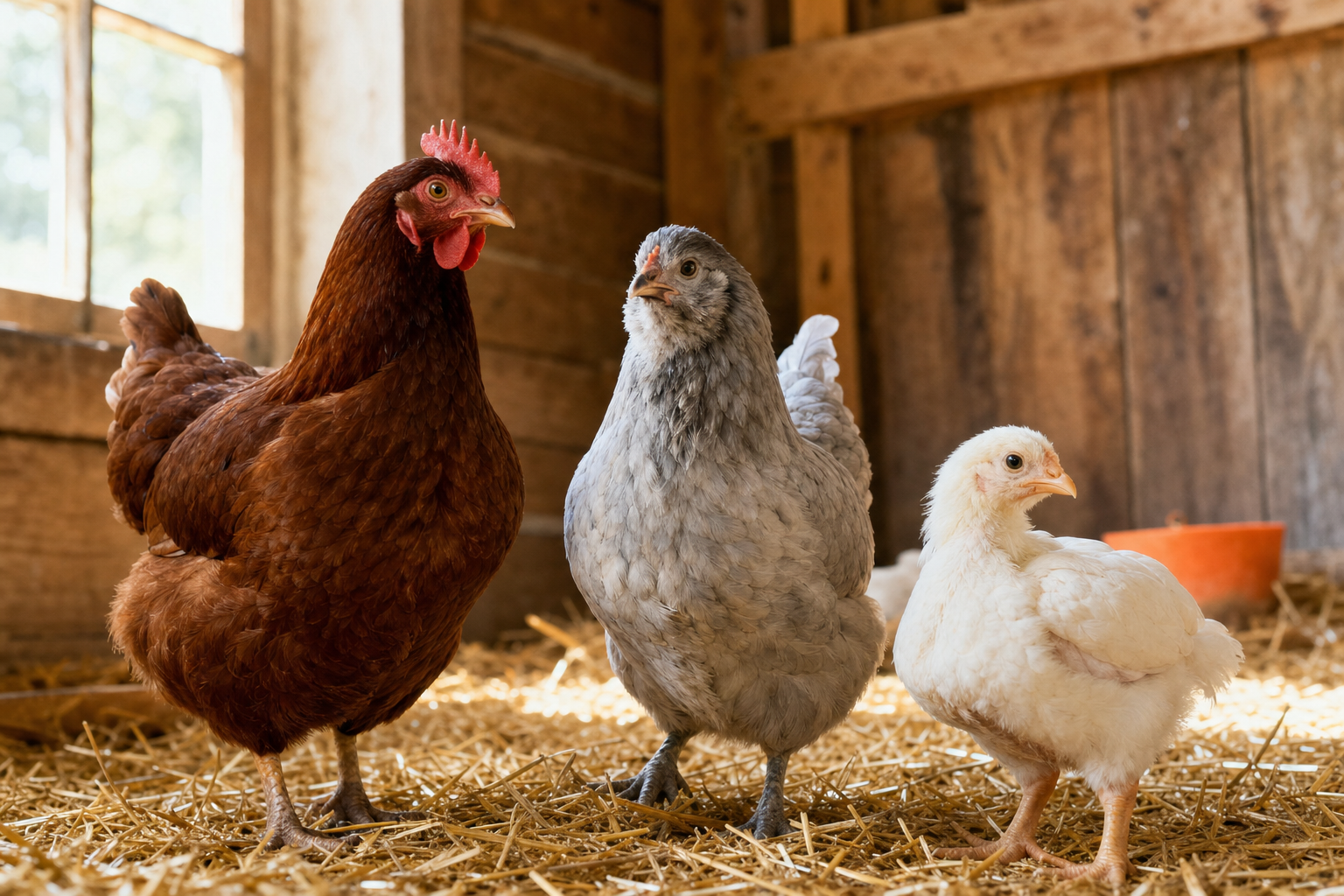
Start with purpose. Laying hens and meat birds are different purchases with different timelines. If you want eggs, think about production rate, temperament, and egg color. A high-volume brown-egg layer like a Rhode Island Red or Cinnamon Queen will outproduce a more exotic bird by a wide margin. If you want a colorful basket, mix in some Marans or Ameraucanas, but anchor the flock with a dependable layer so you’re not short on eggs during molt. For a full breakdown of traits by breed, our guide to the best laying hen breeds covers egg output, temperament, and cold hardiness side by side.
Meat birds are a different calculation. Cornish Cross are ready to process at 8 weeks. Rangers take 10 to 12. The breed you pick determines your processing date, which means you need to work backward from when you want to be in the freezer. Don’t order meat birds without knowing that date first.
Timing matters more than most people expect. You’re not picking a delivery date the way you would with an Amazon order. You’re picking a ship week , and the chicks typically arrive on a Wednesday or Thursday within that window. Clear your calendar for the full week. Most hatcheries open their booking windows in mid-November for the following February through October season. Good availability on popular breeds disappears quickly, so if you know what you want, lock it in early.
Also think about your weather. Chicks heading outside at 6 to 8 weeks should be walking into reasonable conditions. An April hatch date gets birds outside in June. A February hatch in a northern climate puts 6-week-old chicks outside in March, which takes more management. If you brood indoors, the outdoor timing matters less for the first weeks, but it still affects how hard the coop transition will be.
Pro Tip: If you’re raising meat birds alongside layers, order them on separate orders. Most hatcheries can ship them at different times, and it keeps your brooder management cleaner since Cornish Cross grow faster and have different feed needs from day one.
Step 2: Compare hatcheries on price, shipping, and guarantees
The per-chick price you see on a hatchery product page is almost never the number that matters. Shipping, handling, the USPS live-animal surcharge, and small-order fees stack on top. You need to build the full cart before you can compare.
To show you what that looks like: a direct comparison of 25 female Rhode Island Red chicks across several popular hatcheries showed total costs ranging from roughly $130 to over $166 for the same quantity of the same breed. The cheapest per-chick price didn’t always win. One hatchery that looked expensive on the product page had shipping baked into the chick price, while another that looked cheap charged a separate shipping and handling fee plus a $15 USPS surcharge added at checkout. The USPS now requires a $15 non-refundable surcharge on all live poultry shipments, and some hatcheries display it separately while others fold it into their listed rates.
Two hatcheries worth knowing well:
Cackle Hatchery ships throughout the United States and offers one of the broadest species lists you’ll find: chickens, ducks, geese, heritage and broadbreasted turkeys, peafowl, pheasants, guinea fowl, quail, and chukars. Their minimum order is three day-old chicks, which is useful if you only need a small top-up. Their health guarantee covers safe and timely live delivery. Shipping costs vary by order size and destination, so build your full cart before comparing.
Meyer Hatchery uses a specific 48-hour livability policy: chicks are covered during shipping and for 48 hours after you pick them up. That numeric window is more useful than a vague “live arrival guarantee” because you know exactly what the coverage period is and when to report a problem.
Here’s a quick decision matrix for what to check on any hatchery before you place an order:
| Factor | What to look for | Red flag |
|---|---|---|
| Health guarantee | Specific time window (e.g. 48-hour policy) | Vague “we guarantee healthy chicks” with no terms |
| Shipping fee | All-in cart total including USPS surcharge | Surcharge added only at final checkout |
| Minimum order | Published clearly on product page | Small-order fee buried in FAQs |
| Ship date transparency | Confirmation email with specific ship week | No date until after payment |
| Species range | Lists every species offered by name | Generic “poultry” with no breed details |
| Order changes | Clear cancellation and change policy | No changes after order placed; $15 cancellation fee |
One thing worth flagging: some hatcheries you find online are middlemen. They don’t hatch birds themselves , the chicks actually ship from a third-party facility that may be several states farther from you than the company’s listed address. A longer shipping route means more time in transit, which increases stress and DOA risk. Always check where the birds actually ship from, not where the company is headquartered.
If you want to find hatcheries closer to your county rather than defaulting to a national operation, The Easy Homestead directory lists hatcheries searchable by location, so you can see what’s operating within a reasonable drive or short shipping window from you.
Step 3: Understand the full cost before you place the order
Add everything up before you hit confirm. The sticker price on a chick page is only the starting point.
Here’s what actually goes into your total:
- Per-chick price: Varies by breed, sex, and quantity. Buying 26+ often drops the price per bird compared to 25 or fewer. If you’re close to a tier threshold, it may be worth rounding up.
- Shipping and handling: Typically a flat base fee plus a per-bird charge. Pricing varies by hatchery and order size, so build your full cart at each hatchery before comparing.
- USPS live-animal surcharge: A mandatory, non-refundable $15 added to every live poultry shipment. Some hatcheries show it as a line item; others fold it in. Either way, you’re paying it.
- Small-order fees: Orders under 15 birds often carry an additional $20 charge at some hatcheries. Ordering fewer than the minimum quantity to avoid this fee is rarely worth it , either find someone to split the order or round up your numbers.
- Taxes: Varies by state. Budget an extra $5 to $10 depending on where you live.
- Optional add-ons: Vaccination, grow-gel packets, and priority loading are real line items. Grow-gel is worth the few dollars , it gives chicks an energy boost during the first hours after arrival.
- Cancellation fees: Some hatcheries charge a flat $15 cancellation fee if you need to cancel after booking. Read the policy before you commit.
Ordering 25 birds looks cheap until you build the full cart. Run the numbers at checkout before you compare hatcheries, because a lower per-chick price at one facility can easily be wiped out by a higher shipping fee at the same place.
One usable move: splitting an order with a neighbor or someone from a local Facebook group gets you past minimum thresholds and drops your per-bird shipping cost without forcing you to take more birds than you need. If you’re planning to process meat birds, our guide to buying meat chickens has more on how to time and size your orders around processing dates.
Key Takeaway: Build the full cart total , chick price, shipping, USPS surcharge, small-order fees, and taxes , before comparing hatcheries. The per-bird sticker price almost never tells the whole story.
Step 4: Set up your brooder before the chicks ship
Your brooder needs to be running and at temperature before the hatchery ships. Not the day the chicks arrive. Before they ship. You want everything dialed in so that when you get that 5:30 a.m. call from the post office, the only thing you’re doing is driving to pick up the box.
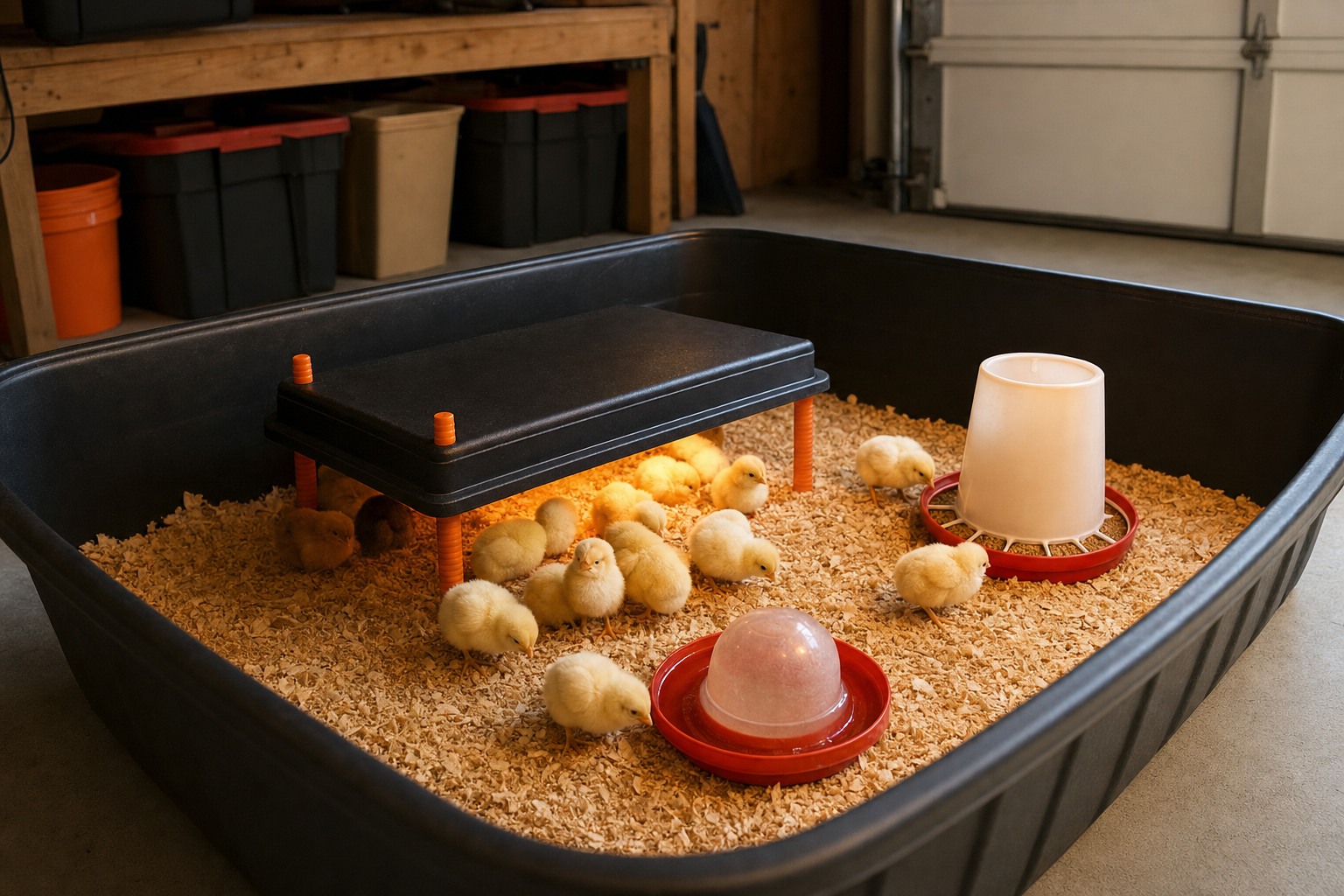
A brooder is just a warm, draft-free, contained space where chicks live until they can regulate their own body temperature , typically 6 to 8 weeks. For small batches, a large plastic storage tote or a galvanized stock tank works fine for the first two weeks. Plan to expand or move to a larger setup around week 2 to 3, because chicks grow fast. The general rule is at least 0.5 square feet per chick at the start, expanding to 1 square foot by week 4. Avoid wire-bottom containers , chick legs need solid footing.
Temperature is the most important variable. Day-old chicks need 95°F directly under the heat source, dropping by 5°F per week until they’re fully feathered around week 6. Use a thermometer at chick level , not at the top of the brooder , to get an accurate read.
Heat plates are better than heat lamps. They mimic a mother hen: chicks tuck underneath to warm up and move away when comfortable. They’re safer (no fire risk), more energy-efficient, and produce calmer birds. Heat lamps are a leading cause of barn fires and should be avoided when you have a better option. Watch your chicks to confirm the temperature is right. Huddled directly under the heat means they’re cold. Pressed against the walls means they’re too hot. Spread evenly and active means the temperature is right.
Bedding should be 2 to 4 inches of absorbent material. Pine shavings work well. Hemp bedding is even more absorbent and dust-free, which helps with respiratory health. Avoid cedar shavings (toxic to chicks), newspaper (too slippery, causes spraddle leg), and fine sawdust (respiratory hazard). Change or top up the bedding often , wet bedding moves you toward illness faster than almost anything else in the brooder.
Feed and water setup: use chick starter feed from day one, formulated at 18 to 22% protein in a fine crumble. If your chicks were vaccinated for coccidiosis at the hatchery, use unmedicated starter to avoid interfering with the vaccine. Fresh water in a shallow chick waterer must be available from the moment they arrive. Deep containers are a drowning risk. Put marbles or clean pebbles in the water tray for the first few days.
Step 5: Handle the post-office pickup and first 48 hours
The post office will call when the box arrives, usually early morning. Go immediately. Don’t wait until after breakfast. Chicks that have been in a shipping box for 48 to 72 hours are hungry, thirsty, and stressed , every extra hour matters.
When you pick up the box, listen. Loud, vigorous peeping is a good sign. Silence is not. Open the box as soon as you’re in the car if you’re concerned, and turn on your seat warmers. A few hatchery customers have noted this as a simple way to give chicks a few degrees of warmth on the drive home.
Check for dead on arrival (DOA) birds before you leave the post office if possible , or as soon as you get home. DOA is a real possibility with mail-order chicks. It doesn’t mean the hatchery did something wrong; shipping stress, temperature swings during transit, and humidity extremes in aircraft cargo holds all take a toll on day-old birds. One creator who regularly orders from Meyer Hatchery described opening a box to find one DOA lavender Orpington alongside a healthy batch of other breeds , the rest of the order was fine. When it happens, contact the hatchery’s customer service with your order number and a count. Most hatcheries will refund the per-bird purchase price, and significant losses sometimes result in a reship.
Meyer Hatchery’s 48-hour livability policy is a good benchmark for what a reasonable guarantee looks like: chicks are covered during shipping and for 48 hours from pickup. That’s the window to monitor carefully and to report any deaths. After 48 hours, you’re outside the covered period for most hatcheries.
First hour at home: dip each chick’s beak into the water trough before you set them down. This teaches them where the water is. Mix grow-gel with water if you ordered it , it gives them an electrolyte-rich start that helps offset the dehydration from transit. Watch that every bird finds the water within the first 30 minutes. Any chick that’s listless, not drinking, or standing with its eyes closed needs close attention. Separate weak birds into a small warm space with water nearby and check them frequently.
For the first 48 hours, keep the brooder quiet and minimize handling. Let them settle. You’ll have weeks to interact with them. Right now, their job is to eat, drink, and warm up.
When ordering online is not the right move
Mail-order chicks make sense for specific breeds, large quantities, or locations where local options are thin. But they’re not always the best call.
If you only need three or four birds to top up a flock, the math rarely works. You’ll pay a small-order surcharge, the full USPS fee, and shipping on a tiny order. A local feed store or a breeder you find through a farm Facebook group will get you birds faster, cheaper, and with less stress on the chicks.
Feed stores in spring are a real option. Most Tractor Supply locations and independent farm stores run weekly chick days from late February through early summer. You can see the birds before you buy, skip the shipping entirely, and take them home that day. The trade-off is breed selection , you get what the store ordered, which tends to be popular production breeds. Rare breeds, heritage turkeys, or specialty waterfowl won’t be on that shelf.
Local breeders and small hatcheries are worth finding. If there’s an NPIP-certified operation within a few hours of you, buying directly eliminates shipping stress entirely and often gives you birds with better starts than anything that spent two days in a USPS distribution center. The problem is finding them. That’s exactly the gap The Easy Homestead directory was built to fill , search by ZIP code or county to find verified hatcheries and poultry suppliers near you, rather than spending three weeks in a Facebook thread trying to track down a local source.
Also consider fertile hatching eggs if you already have an incubator or a broody hen. Eggs ship better than live chicks in some respects, though hatch rates vary and you won’t know what you’ve got until day 21. It adds a layer of uncertainty that mail-order day-olds don’t have.
The honest answer: if you’re after common production breeds in quantities of 15 or more, mail-order from a reputable national hatchery is efficient and cost-effective. If you want rare breeds, small quantities, or the shortest possible transit time, look local first. The Easy Homestead makes that search faster , browse verified hatchery listings and poultry suppliers without the guesswork.
FAQ
What is the minimum number of chicks I can order online?
It depends on the hatchery. Cackle Hatchery’s published minimum is three day-old chicks, though orders under 15 birds typically carry an additional small-order fee. Meyer Hatchery can ship as few as three chicks, but shipping on that small a quantity runs close to $50. Most buyers find 15 chicks to be the usable minimum where shipping costs become reasonable per bird.
How long does it take to receive chicks after ordering?
You choose a ship week at checkout, typically 2 to 6 weeks out from your order date. Once shipped, chicks travel by USPS Priority Mail and usually arrive within 1 to 3 days. Most buyers receive their chicks on a Wednesday or Thursday of the selected ship week. Popular breeds book out fast, especially early in the season, so order as soon as you know what you want.
What should I do if chicks arrive dead on arrival?
Contact the hatchery customer service the same day with your order number and a count of DOA birds. Most hatcheries will refund the purchase price for dead chicks; larger losses may qualify for a reship. Meyer Hatchery has a 48-hour livability policy that covers deaths during shipping and for 48 hours from pickup. Document everything before you call , photos help if there’s any dispute.
Is it safe to ship chicks through the mail?
Chicks hatch with a yolk sac that sustains them for roughly 72 hours without food or water, which is what makes mail shipping possible. That said, shipping does add stress. Temperature swings, humidity extremes in cargo holds, and long transit times all affect chick health. Ordering from a hatchery closer to your location, avoiding winter shipping, and having the brooder ready before pickup all reduce risk meaningfully.
Can I order chicks online if I only want a few breeds?
Yes. Most hatcheries let you mix breeds in a single order as long as you meet the minimum quantity. If you want five birds of breed A and ten of breed B, you can usually do that in one cart. Just check that both breeds are available on the same ship date , rare or exotic birds sometimes have later availability than common production breeds, which can push your whole order back.
Where can I find a local hatchery instead of ordering nationally?
The Easy Homestead directory lists verified hatcheries and poultry suppliers searchable by ZIP code or county. It covers smaller regional operations that don’t show up on generic search results. If you’re looking for a source within a short driving distance, or want to compare what’s available locally before committing to a national hatchery, that’s the fastest place to start.
Wrapping up
The biggest mistakes in ordering chicks online are fixable with a little lead time: know your breed and purpose before you shop, build the full cost at checkout rather than going by sticker price, and have the brooder running before the birds ship. If you want to skip the national hatchery and find a local source first, search The Easy Homestead directory by your county. For everything that comes after the brooder, our guide to raising baby chicks covers week-by-week care once your flock is home.