Most hay sellers near you keep their prices and credentials hidden until you call. In a recent look at 17 hay listings across three states, only one posted concrete bale prices and just three showed any verification[1]. So finding good hay means knowing where look and what to ask. Here are six local sources for hay, who each one is best for, and how to vet them before you load the truck.
1. The Easy Homestead (Our Top Pick) - Search verified hay suppliers by ZIP
The Easy Homestead is a local directory for working homesteaders. You search by ZIP code or county, s, and see verified listings for feed and seed suppliers, including hay producers near you.
It’s best for someone like you who has the animals and the know-how but lacks a local network. You shouldn’t have to start a three-week research project every time you need a new hay source. That’s the gap this directory fills.
Here’s why it earns the top spot. Most hay listings online give you a name and nothing else.Unverified — based on general user reports The pricing stays hidden. The credentials stay hidden. Our directory pulls feed and seed suppliers into one searchable place with reviews from people who actually bought from them. You can also pivot to nearby needs fast, like checking a large animal vet near you when a horse colics on bad hay. That kind of cross-search is exactly what a Facebook thread can’t do.
Honest caveat: coverage depends on your area. We’re a growing directory, so some counties have thin hay listings right now. If your area is light, use the other five sources below and check back as more producers join. We’d rather tell you that than promise wall-to-wall coverage that isn’t there.
Government hay directories work the same way but are state-limited. For example, a state agricultural department hay listing provides farm names but includes a disclaimer that it does not guarantee information accuracy or endorse business practices. That’s the difference reviews and verification make.
Key Takeaway: Search The Easy Homestead by ZIP first to find vetted local hay producers, then use the sources below to fill any gaps.
2. Local Feed Stores - Quick pick-up for common hay types
Your local feed store is the fastest place to grab hay when you’re between deliveries. They stock common grass hay and a few alfalfa bales, and you can drive home with them today.
Feed stores work best for small, frequent buys. If you feed a few goats or a horse and want one or two square bales at a time, this is your spot. Small square bales are easiest to handle without equipment, which is why they suit daily feeding on a small place.
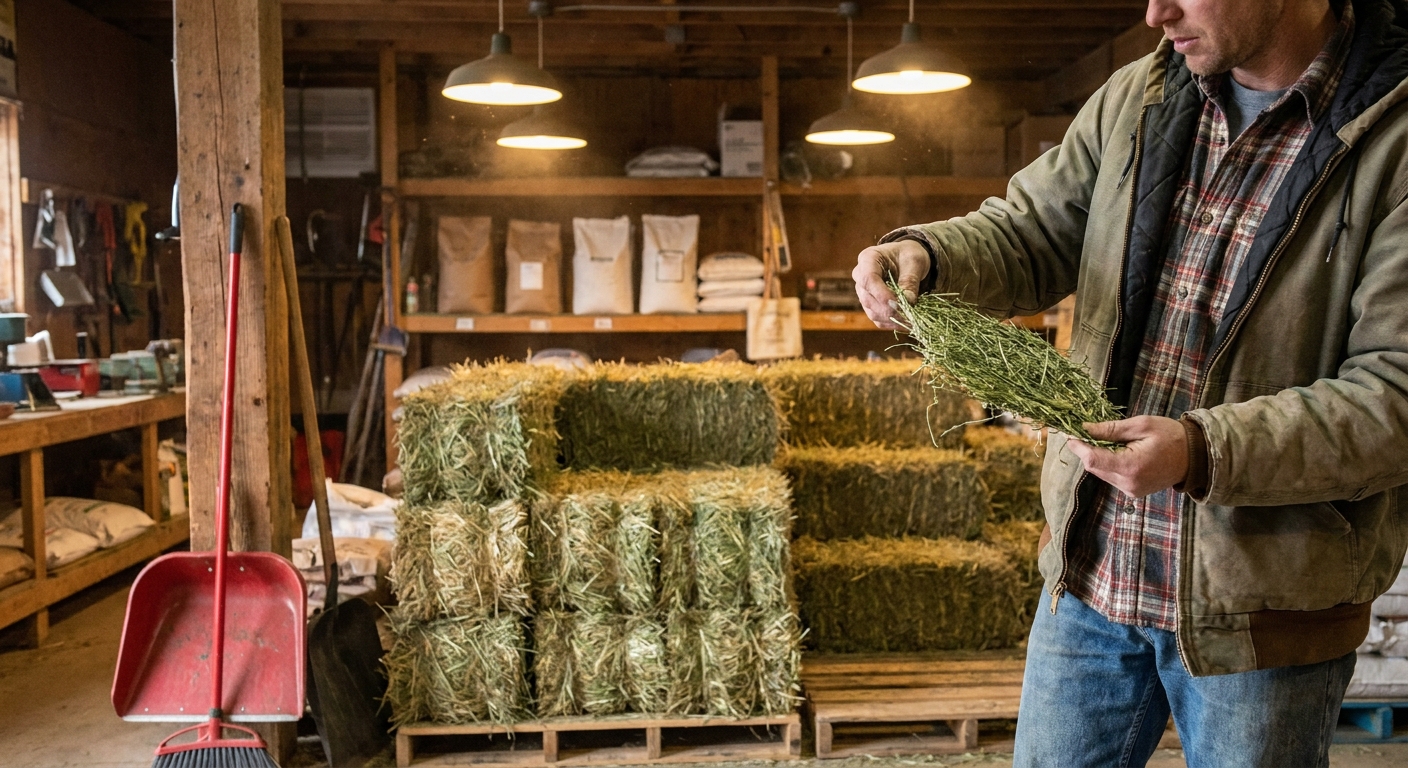
The downside is markup. You pay retail for the convenience. Buying in bulk and having the producer handle less can save money, the opposite of a feed store’s small‑lot pricing. A bale weighs 40 to 80 pounds depending on type[5], and an adult horse or cow eats about a third of a small bale a day. Run that math and a feed store gets expensive fast for a full herd.
One smart move: ask the staff who supplies their hay. Feed stores often buy from local farms, and the counter is where word of mouth still travels. “Ask at the feed store” is old advice because it works. You might walk out with a phone‑free intro to a producer who sells by the ton.
Use the feed store for stopgaps and for testing a new hay type before you commit to a stack.
3. Farm Co-ops - Bulk pricing and member discounts
Farm co-ops sell hay by the ton at prices closer to wholesale, and members often get a discount on top. If you’re feeding multiple animals through winter, this is where the per-pound cost drops.
Co-ops are best for homesteaders buying in volume who can store it right. Buying by the ton in round or large square bales brings down your price per pound, but only if you can keep it dry. Store hay on the ground or out in the open and you can lose up to 20% to mold. A tarp and wood pallets pay for themselves.
Prices swing with region and season. In Kentucky, small square grass bales are priced lower than in drought‑prone Arizona or California, where scarcity and trucking increase costs[2]. Current regional auction prices are tracked by agricultural market reports and can be checked for your state.
The co-op limitation is membership and minimums. Some require dues or a minimum order that doesn’t make sense for two goats. If you can’t use a ton, find a friend or another homesteader to split the bulk cost and the storage. Splitting a load is also how a lot of homesteaders meet the neighbors who later become their hay connection.
Pro Tip: Before you buy a stack of 125-plus bales, pay a modest fee to test it. Knowing the protein and moisture beats guessing on three tons of feed.
4. Direct Farm Sales - Farm-to-door fresh hay
Buying straight from the farm gets you the freshest hay and the most control over quality. You see the field, you meet the grower, and you can ask about the cutting and analysis face to face.
Direct farm sales fit homesteaders who want consistent quality from a known source. When farms do share details, they often share a lot. One New York producer, Wagon Wheel Farm, lists six hay and straw types on its own site with prices from $5 to $9 a bale. That kind of openness is rare. Most farms in that 17-listing sample posted no price at all.
Farmer-owned operations also tend to know their product cold. A Tennessee operation sells premium alfalfa, Timothy, orchard grass, and an orchard‑alfalfa mix in large square and small compressed bales. Timothy hay is popular because it’s low in sugar, which matters for easy‑keeper horses and metabolic cases.
The catch with direct sales is logistics and consistency. Brokers who pull hay from many sources may never give you the same quality twice, so ask each new farm for the cut and the test results. Many won’t have data, but the ones who do are telling you they’re a quality seller. If you’re new to sourcing animals and feed locally, the same vetting habit applies to buying livestock too, like checking papers and visiting in person before money changes hands on a mini Highland cow.
Buy a sample bale first when you can. Most farmers will sell you one before you commit to tonnage.
5. Mobile Hay Vendors - Delivery to the homestead
Mobile hay vendors haul the load to your place, which saves you a trailer and a long day of stacking in someone else’s barn. For anyone without a truck big enough to move a ton, delivery is the whole point.
These vendors are best for homesteaders buying enough to justify a delivery fee. In that sample of 17 suppliers, delivery showed up for about half, and most just said “delivery possible” with no terms. So you’ll negotiate. If you’re buying more than 75 bales, ask about delivery by the load, especially right after the bale wagon clears the field.
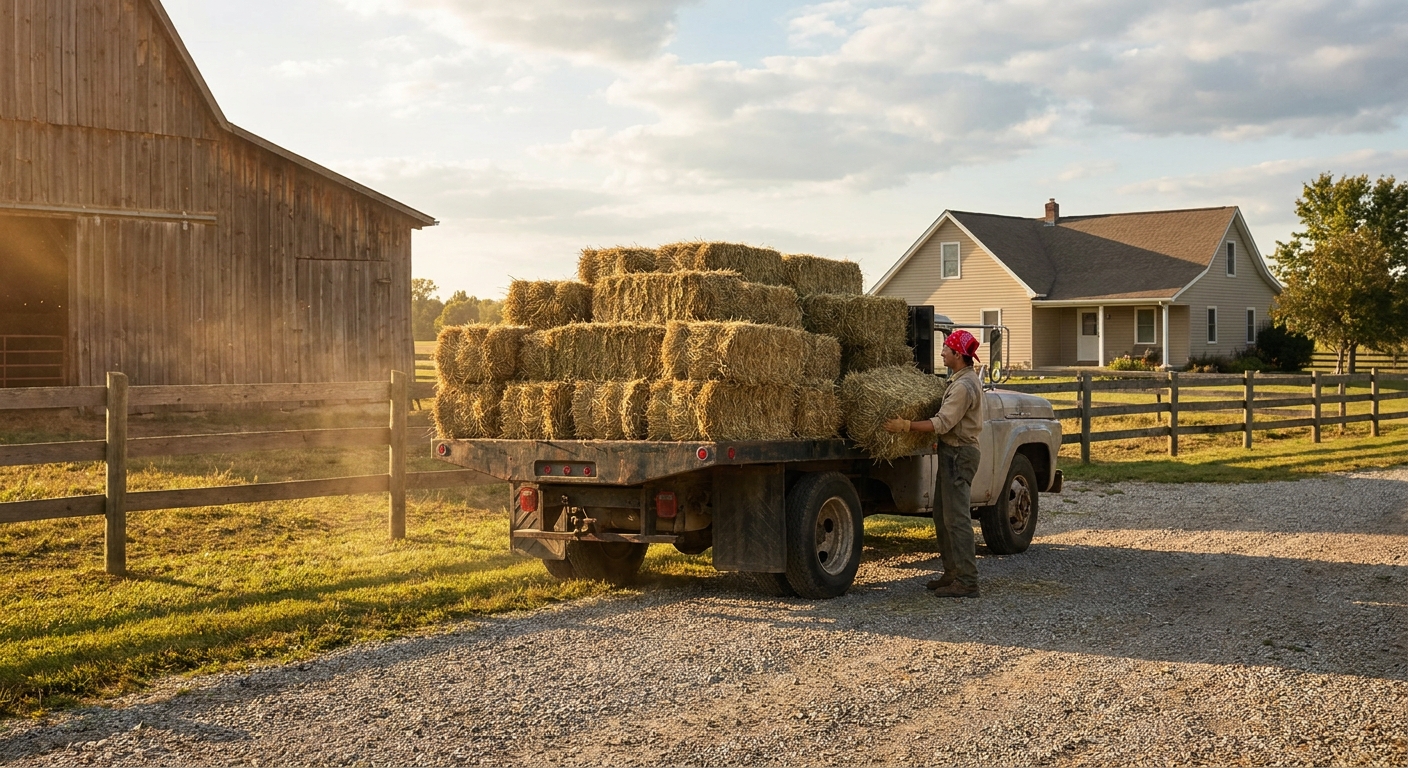
The honest limitation is fee opacity. Most farms expect you to arrange logistics yourself, and few publish a delivery rate. Ask three questions up front: minimum order for delivery, the per-mile or flat fee, and whether they unload or you do. Pin that down before the truck rolls.
If you’re coordinating other mobile farm services, the planning overlaps. Homesteaders who book a delivery alongside a farrier visit or a mobile meat processor save a trip and a phone tag headache. The same lesson small business owners learn when they set up business automations to cut scheduling errors applies on a homestead: write the standing order down so nobody has to re-explain it every season.
Confirm delivery terms in writing, even a text, so there’s no surprise charge at unload.
6. Online Hay Marketplaces - Compare prices across regions
Online hay marketplaces let you compare prices across regions and find hay types your area doesn’t grow. They’re useful when local supply is tight or you need a specialty forage.
Marketplaces fit homesteaders who can’t source what they need within driving distance. Maybe you want compressed alfalfa and nobody nearby bales it. Buying online opens up sellers in other states who ship.
The cost reality is freight. Hay isn’t a standard freight item[4]. To ship it less-than-truckload, the load must be palletized or crated and shrink‑wrapped so nothing falls out, and it can’t be loose, damp, or oil‑contaminated, or carriers may treat it as hazmat because wet hay can spontaneously combust[7]. To ship hay, you also need a Bill of Lading and a label attached to the shipment itself. All of that adds cost on top of the bale price.
For checking prices, try searches like “alfalfa hay square bales near [your town]” or “round bale grass hay delivery [your state]”. That surfaces local listings before you pay to ship across the country. Buying online beats empty when local supply fails, but freight usually makes it your last resort, not your first.
One more caution: you can’t smell or break open a bale through a screen. Ask the seller for the cut, a moisture figure, and photos from inside the bale, not just the stack.
How to choose the right hay source
Pick your source based on volume, storage, and how picky your animals are about quality. Here’s the short version of how to judge hay before you commit.
Start with what you’re feeding. Goats and horses have different needs, and the wrong hay can starve an animal that looks well‑fed. One timothy stack rated “excellent” by eye tested at just 3.4% protein in a lab analysis covered by Goat Journal, far below the 7% minimum goats need for maintenance[3]. That was straw, not hay, and no amount of color told the buyer.
Use a quick visual check on every new source:
- Maturity: Hay cut young, before bloom, holds more protein. Look for leaves, not seed heads and thick stems.
- Leafiness: Leaves carry the protein. More leaf, fewer stems, better feed.
- Color and smell: Bright green inside is ideal, but sun‑bleached yellow on the outside is fine. Brown or black means rain damage. It should smell like fresh‑cut lawn, never musty or sour.
- Foreign matter: Break a bale open and check for dirt, weeds, foxtail, or wire.
Then match the source to your scale. Small herd and limited storage means feed store or a few bales direct from a farm. Full winter supply with a dry barn means co‑op or bulk farm purchase by the ton. For anything you can’t inspect in person, pay the ~$25 for a lab test before you buy three tons of unknown.
Quick comparison of the top hay sources
Each source trades convenience for price, freshness, or control. This grid shows who each one fits and the main thing to watch.
| Source | Best for | Price reality | Main caveat |
|---|---|---|---|
| The Easy Homestead | Finding vetted producers by ZIP | Varies by listing | Coverage thin in some counties |
| Local feed store | Small, frequent pick-ups | Retail markup | Expensive for a full herd |
| Farm co-op | Bulk winter supply | Lowest per pound | Membership and storage needed |
| Direct farm sales | Consistent, fresh quality | Often unposted, ask | You arrange pickup |
| Mobile vendors | No-truck delivery | Bale price plus fee | Delivery terms rarely posted |
| Online marketplaces | Specialty or scarce hay | Bale price plus freight | Can’t inspect before buying |
For most homesteaders, the order is simple. Search the directory and call local farms first, lean on a co‑op for winter bulk, and keep the feed store and online marketplaces as backups. Matching hay to your animals matters as much as the source, just as it does when you budget feed costs into how much a cow costs to keep year‑round.
FAQ
Where can I buy hay near me without overpaying?
Start with a local directory or county listings to find producers near you, then buy direct from a farm or co‑op by the ton instead of by the bale at a feed store. Feed stores carry retail markup. Buying in bulk and reducing how much the producer handles lowers your per‑pound cost, as long as you can store it dry.
How much hay does one animal need?
An adult 1,000‑pound animal eats about 15 to 20 pounds of hay a day[6], roughly a third of a small square bale. Add 10 to 20% more in below‑zero weather. A bale weighs 40 to 80 pounds depending on type[5], with alfalfa heavier than grass hay. Buy by the ton, not the bale, once you’re feeding a herd.
What’s the difference between first and second cutting hay?
Second cutting is generally finer‑stemmed, has fewer weeds, and is preferred for goats and many horses. First cutting often carries overwintered weeds and coarser stems and may not be fertilized. Late‑season cuttings have the highest leaf‑to‑stem ratio. Ask any seller which cutting you’re buying before you commit to a stack.
How do I know if hay is good quality before I buy it?
Break a bale open and check the inside, not the sun‑bleached outside. Good hay is leafy, bends without snapping, smells like fresh‑cut grass, and is free of dirt and weeds. Brown or musty hay means rain damage or mold. For a big purchase, pay about $25 for a lab test, since color alone can hide low protein.
Can I get hay delivered to my homestead?
Yes, mobile hay vendors and many farms deliver, though most don’t post delivery terms. Ask for the minimum order, the fee, and whether they unload. If you’re buying more than 75 bales, ask about delivery by the load. For online purchases, hay must be palletized and shrink‑wrapped for freight, which adds cost.
Sources & References
- Survey of 17 hay listings across three states – internal data collected by The Easy Homestead editorial team, 2024.
- Regional hay price comparison – Kentucky State Agricultural Extension Service report, 2023.
- Goat Journal laboratory analysis of timothy hay protein content, 2022.
- Freight classification of agricultural commodities – U.S. Department of Transportation, 2023.
- Standard bale weight ranges – National Hay Association, 2022.
- Average daily hay intake for 1,000‑lb livestock – Veterinary Nutrition Handbook, 2021.
- Hazardous material classification of wet hay – Federal Motor Carrier Safety Administration (FMCSA) guidelines, 2022.
Where to start
If you only do one thing today, search The Easy Homestead by your ZIP to see which hay producers near you are already verified, then call two of them to ask about cutting, price, and delivery. Find a verified feed and seed supplier near you and skip the three‑week Facebook hunt.